

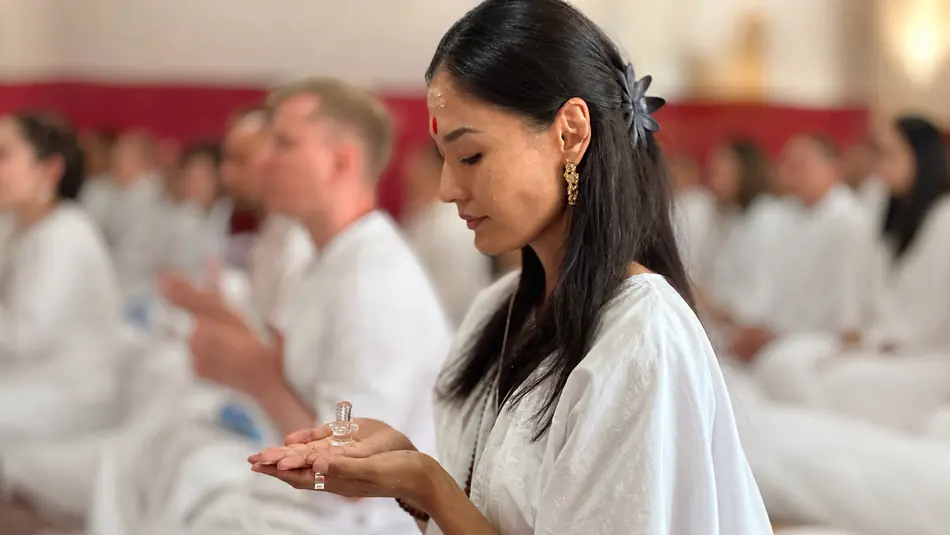
The Path of Liberation, moksha-dharma, is not just one of many paths. It is a path that leads beyond samsara, beyond karma, and beyond conditioned existence.
Entering this path does not begin with techniques, practices, or rituals. It begins with an inner revolution of consciousness.
Before a person becomes a disciple of a Guru and a part of the sangha, certain foundations must mature within them.
To practice moksha-dharma deeply within the tradition, it is necessary to give rise to three great states of consciousness.
1. Great skepticism toward samsaric ignorance
The first is great skepticism toward samsara, its values, promises, and illusions. Skepticism here does not mean a denial of life or nihilism. It means a direct understanding of the limitations of samsaric meanings.
A person clearly sees:
- the impermanence of all things conditioned,
- the inevitability of suffering,
- the impossibility of final satisfaction within samsara.
This understanding gives birth to a mature disillusionment, which becomes the fuel for the Path.
2. Great faith in Sanatana Dharma
The second foundation is great faith.
Faith in:
- Sanatana Dharma,
- the teachings of the Advaita Siddhas,
- moksha-dharma as the supreme Path,
- the Refuge,
- the lineage,
- the root Guru and the saints.
This is not blind faith, but faith joined with awareness. It makes the Path alive and effective.
3. Great resolve to move toward Liberation
The third foundation is great resolve, or virya.
This is an unbending intention to:
- move toward Liberation,
- not turn away during difficulties,
- not retreat before doubts.
In the tradition, this is called mumukshutva — the thirst for Liberation. Without this resolve, the Path breaks down into episodes. With it, it becomes irreversible.
Contemplating the Refuge
Once the three great foundations have awakened, the next step is a deep understanding of the Refuge.
The seeker:
- studies the principles of guru yoga,
- grasps the meaning of samayas and pure vision,
- realizes the qualities of the Guru and the disciple,
- becomes familiar with the ethics of spiritual relationships.
They study the Refuge Tree — the deities and saints of the lineage — and learn to relate to the Refuge correctly.
Veneration of the Refuge and Upasana
The seeker learns to:
- venerate the Refuge,
- express respect,
- praise and invoke,
- make offerings,
- perform daily upasana at the altar,
- observe special days of veneration.
This creates a flow of blessings, purifies karma, and harmonizes one’s destiny.
The Creed as a Conscious Acceptance of the Path
At this stage, the seeker becomes acquainted with:
- the short and fivefold Creed,
- its expanded version.
The Creed is accepted:
- sincerely and with the whole heart,
- first independently at the altar,
- then personally from a monk.
Setting up an altar or participating in the life of the ashram becomes an external reflection of an internal choice.
Study of the Teaching and Service to Dharma
After this, the seeker proceeds to:
- studying sacred texts,
- performing basic practices,
- analytical meditations,
- mantra sadhana.
Simultaneously, they begin seva — service to the Dharma. This purifies destiny and reveals inner strength. It is important to pray to the saints of the Refuge and the goddess of wisdom to grant the qualities of a true disciple — a pure vessel for the Teaching.
Initiation — Diksha
In time, readiness for initiation comes:
- receiving a spiritual name,
- the guru mantra,
- taking vows and samayas,
- obtaining the status of a karma-sannyasi.
From this moment, the person is considered fully entered into the spiritual family — the guru-kula and the arya-sangha.
Entering the Stream of Awakening
After diksha, the following is established:
- daily sadhana,
- training,
- retreat rules,
- regular veneration of deities and saints.
Thus begins the great Path of Liberation, which, once started, has no end. This Path is infinite, beyond time, and it depends only on the disciple themselves how they will walk upon it.
May this Path be blessed, auspicious, and successful.
Go to Article 5: “The First Step — Taking Refuge (Sharanagati)”
