

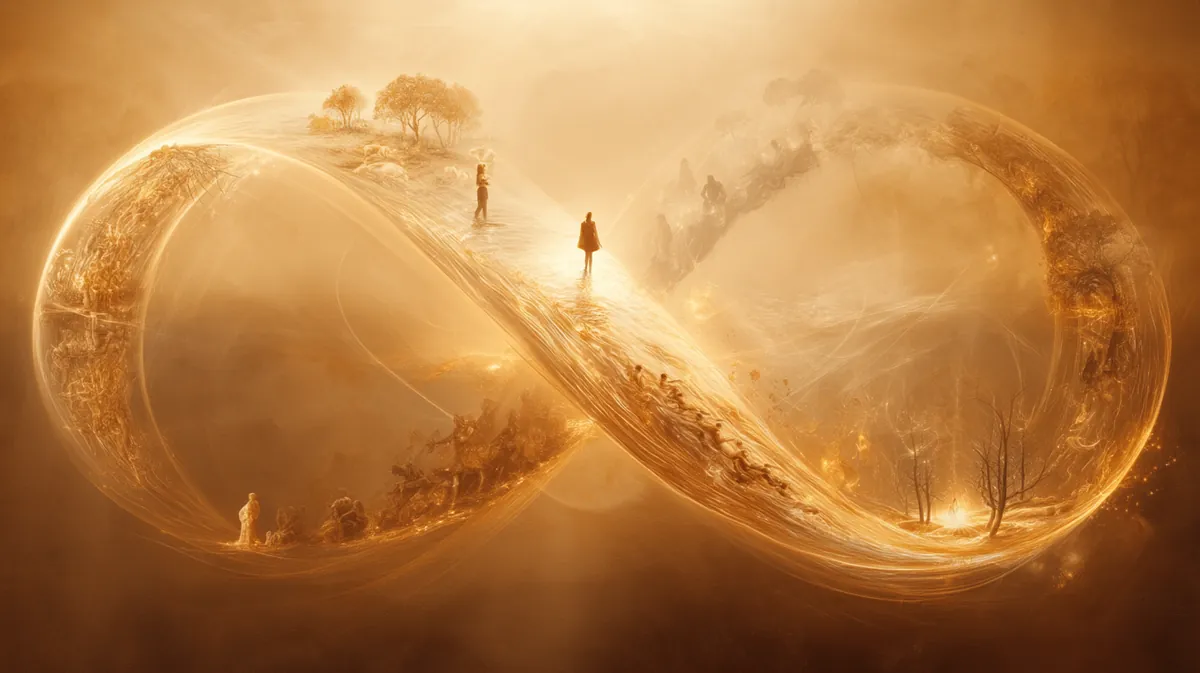
Saṃsāra (Sanskrit: saṃsāra) is the continuous cycle of birth and death in which the soul wanders until attaining Liberation. It is neither a place nor a punishment; it is a state of consciousness conditioned by ignorance of one’s true nature.
The Sanskrit word saṃsāra is formed from the root sṛ — "to flow," "to move" — with the prefix sam, indicating continuity and cyclicality. Literally, it means "unceasing flow" or "endless wandering." In Vedic literature, this term denotes not so much the external world as the very state of involvement in the cycle: birth → action → death → new birth. Closely related expressions are the "wheel of becoming" (bhava-cakra) and the "ocean of existence" (bhava-sāgara).
The Nature of Samsaric Existence
Saṃsāra is a particular domain of the Universe in which the energies of rajas and tamas predominate in a certain proportion. The human world corresponds to its own specific proportion of sattva, tamas, and rajas. Yet it is important to understand that saṃsāra is not the world as such, but first and foremost conditioned vision. It is avidyā (ignorance) that causes the eternal, boundless Self (Ātman) to perceive itself as a limited, suffering being.
Just as a rope in the darkness appears to be a snake, so the world, when seen through the prism of ignorance, gives rise to fear and attachment. Three forces keep the jīva (individual soul) within this cycle: kāma (desire), karma (the fruits of actions), and avidyā. As long as they remain active, the soul takes on new bodies, gross and subtle, in accordance with accumulated saṃskāras (impressions of past experience).
The primary cause of saṃsāra is clinging to ahaṃkāra (ego-sense, the false "I"). To be liberated, one must cut off this clinging from the stream of consciousness. At the same time, detachment from saṃsāra is not a flight into mountains or forests. One may move to an āśrama, but if conditioned vision remains, saṃsāra will go with you.
Samsara as a Field of Spiritual Maturation
It would be a mistake to regard saṃsāra as suffering alone. Every embodiment is an opportunity for the soul to mature, purify karma, and draw closer to recognizing its identity with Brahman. The sages speak not of the "destruction" of saṃsāra, but of awakening from it — just as a sleeper awakens and realizes that the dream was only a play of the mind.
Saṃsāra ends for a particular soul when ignorance is dispelled through jñāna (knowledge), bhakti (devotion), and vairāgya (dispassion). Then comes moksha — final Liberation, in which the jīva realizes itself as the pure Ātman, non-different from Brahman.
"The one who has not known the Ātman is born again and again — like grain that grows, ripens, and is sown once more. But the one who has known does not return again."
— Kaṭha Upaniṣad, 1.1.6
