

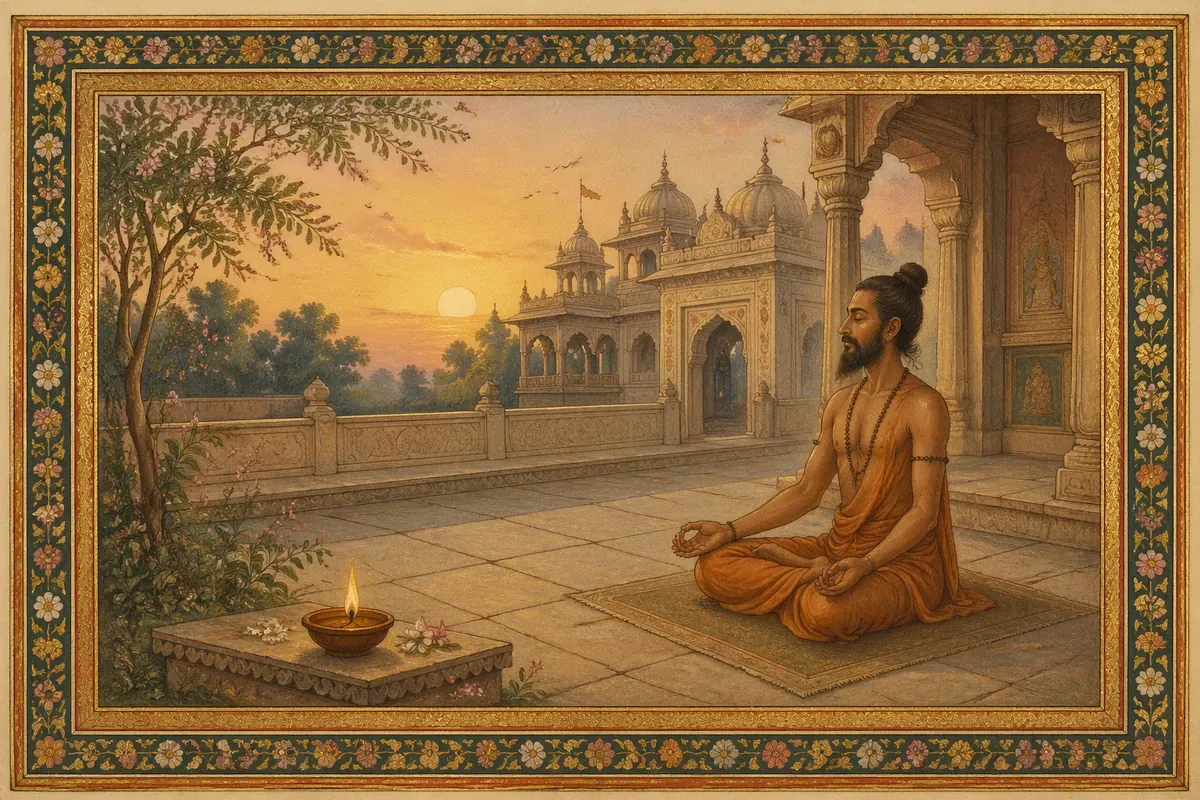
When it comes to asanas, most people imagine gymnastic poses or fitness exercises. However, the tradition of Sanatana Dharma understands this word differently. In Patanjali's "Yoga Sutras" (II.46), asana is defined by two words: sthira-sukham āsanam — "steady and pleasant." It is not the shape of the body, but the quality of being within it. Behind this distinction lies an entire concept.
What is an Asana
The word āsana (Skt. āsana) traces back to the verbal root ās — "to sit," "to abide," "to be at rest." Literally, it means a "seat" or "body position." In a broad sense, it is any stable position in which the body can remain without excessive effort.
The key shastric definition belongs to Rishi Patanjali: sthira-sukham āsanam ("Yoga Sutras", II.46). Sthira means stability and immobility; sukha means lightness, comfort, and the joy of being. An asana that contains only tension without lightness does not yet meet this definition. The reverse is also true: relaxation without stability is not an asana in the traditional sense.
In the context of the "Yoga Sutras," Patanjali primarily referred to the meditative seat — the body's ability to remain still and relaxed during contemplation. The corpus of Hatha Vidya, which developed later, significantly expanded this concept, describing a vast arsenal of physical forms for working with prana (Skt. prāṇa — life force), nadis (Skt. nāḍī — energy channels), and chakras (Skt. cakra — energy centers).
Asana in Sacred Texts
The tradition of asanas is described in several layers of sources belonging to different eras and genres.
The earliest systematic mentions are found in the Agamic literature of Shaivism. The Suprabheda Agama lists eight stages of yogic realization, in which asana is assigned the third place:
"One should know that the efforts of yogic realization are traversed by yogis in eight stages: yama, niyama, asana, pranayama, pratyahara, dharana, dhyana, and samadhi."
— Suprabheda Agama
This enumeration reproduces the classical scheme of Patanjali's Ashtanga Yoga and is firmly established in the Agamic tradition of Shaivism — indicating the wide distribution of this system long before its popularization in the modern world.
The corpus of Hatha Vidya — Svatmarama's "Hatha Yoga Pradipika" (15th century), the "Shiva Samhita," and the "Gheranda Samhita" (17th–18th centuries) — provides a systematic description of asanas as an independent discipline. The "Hatha Yoga Pradipika" describes 15 asanas, the "Gheranda Samhita" lists 32, while the "Shiva Samhita" focuses on the four main meditative poses. Overall, traditional sources mention 84 classical asanas, though legend mentions a much more significant number — 8,400,000, corresponding to the number of forms of incarnation for beings in samsara.
Types of Asanas: A Brief Overview
Classifications of asanas vary across different texts. In practical terms, several main groups are identified.
Meditative asanas (dhyana-asanas) are intended for prolonged sitting in contemplation: padmasana ("lotus pose"), siddhasana ("perfect pose"), sukhasana ("comfortable pose"), vajrasana ("thunderbolt pose"). It is for these that Patanjali's definition — sthira-sukham — applies most fully: the body must remain motionless and yet relaxed for hours.
Active asanas are aimed at purifying the nadis, opening the joints and spine, and activating the flow of prana. They form the basis of most traditional Hatha Yoga sequences and are practiced before pranayama. Inverted asanas (viparita-karana, Skt. viparīta-karaṇī — "reverse action") redistribute the flows of prana and apana (Skt. apāna — descending prana), utilizing mechanisms for the preservation and redirection of life force.
In different schools and lineages, the set of practiced asanas varies significantly. The tradition does not fix a single universal canon: the set of asanas always corresponds to the goals of a specific path and the level of the practitioner.
Place in Ashtanga Yoga
Asana is the third limb of the eightfold path (Ashtanga Yoga, Skt. aṣṭāṅga-yoga) described by Patanjali. It follows yama (ethical restraints) and niyama (personal discipline) and precedes pranayama. This order is not accidental: without observing yama and niyama, the practice of asanas does not achieve its goal. "If we eat meat and do not follow the principles of yama-niyama, then asanas will be useless," points out Swami Vishnudevananda Giri (lecture "Foundations of Sanatana Dharma," 2013).
It is important to understand what an asana is not. It is often equated with physical culture or gymnastics — though the physical effects of practice are obvious, the goal is not flexibility for its own sake. It is mistaken for therapy — though therapeutic results may follow. It is considered the pinnacle of the yogic path — although in Patanjali's system, it is the third of eight stages, a preparatory one. The most widespread misconception is turning asana into a demonstration of physical achievement: this directly contradicts the meaning imbued in the practice by tradition.
In an asana, the body is brought into a state where profound pranayama-sadhana, and subsequently meditation, becomes possible. When the channels are purified, the prana has risen and reached the signs described in the texts — the task of the asanas is complete.
Fruits of Practice (phala)
Classical texts and living tradition agree on the description of the results of systematic work with asanas.
First and foremost is the purification of the nadis. Asanas affect the subtle body: "Asanas should be performed in order to purify your energy channels within the body. Once purified, they will become wider, so energy can circulate freely through them" (Swami Vishnudevananda Giri, lecture 2005). The purification of the nadis creates the necessary condition for deeper practices.
The second result is the untying of the granthis (Skt. grantha — knot, bond). The tradition identifies three energy knots: Brahma-grantha in the area of the muladhara chakra, Vishnu-grantha in the area of the anahata chakra, and Rudra-grantha between the eyebrows. Their untying opens the path for the upward movement of kundalini-shakti (Skt. kuṇḍalinī-śakti — serpent power).
Finally, the body, having become stable and effortless in sitting, ceases to distract the mind from contemplation. This is Patanjali's sthira-sukham — not an ideal pose, but a functional state.
"Besides this, an excellent practice for purifying the channels is the asanas of Hatha Yoga."
— Swami Vishnudevananda Giri (lecture "Pacifying the Mind through Contentment," 2009)
Asana in the Teaching of Laya Yoga
In the teaching transmitted by Swami Vishnudevananda Giri, asanas are assigned a specific place in the structure of sadhana — without exaggeration, but also without diminishment.
Asanas are part of the second section of the five Yantras of Laya Yoga — the section of Kundalini Yoga — and constitute its initial stage. "Asanas are the beginning of the practice of Kundalini Yoga, that is, the second section of the five yantras of Laya Yoga," the Master explains. Their practice precedes pranayama, work with mudras and bandhas, and ultimately — meditation.
The teaching clearly designates the limit of the asanas' task. When the practitioner notices signs of channel purification — a feeling of heat along the spine, the free flow of prana, the vision of chakras, the appearance of amrita — this indicates that the asanas have done their job. Thereafter, they are practiced to keep the channels toned, but the center of gravity shifts toward pranayama and contemplation.
The Master points to the essential goal of this stage: "In reality, asanas are only necessary to control the mind" (lecture 2008). And even more directly, regarding the nature of the gift itself: "Shiva gave [asanas] as a method so that people could raise themselves a little from the bodily concept, from worldly gross desires, and take control of the body, so that they could rise a little to the next stage and go toward Him" (lecture "The Nature of Shiva," 2020).
Asana is valuable not in itself, but as a step. The body is brought into order — prana opens. Prana is balanced — meditation becomes accessible.
In the system of tradition, asana occupies a clear place: a preparatory stage of working with the subtle body, opening the path to pranayama and contemplation. Patanjali's definition — sthira-sukham — places the internal quality of being, rather than the external form, at the center. Traditional texts point to this unanimously.
The practitioner who understands this does not place asana above its position on the path. He performs it regularly — and moves further when the channels signal that the time has come.
