

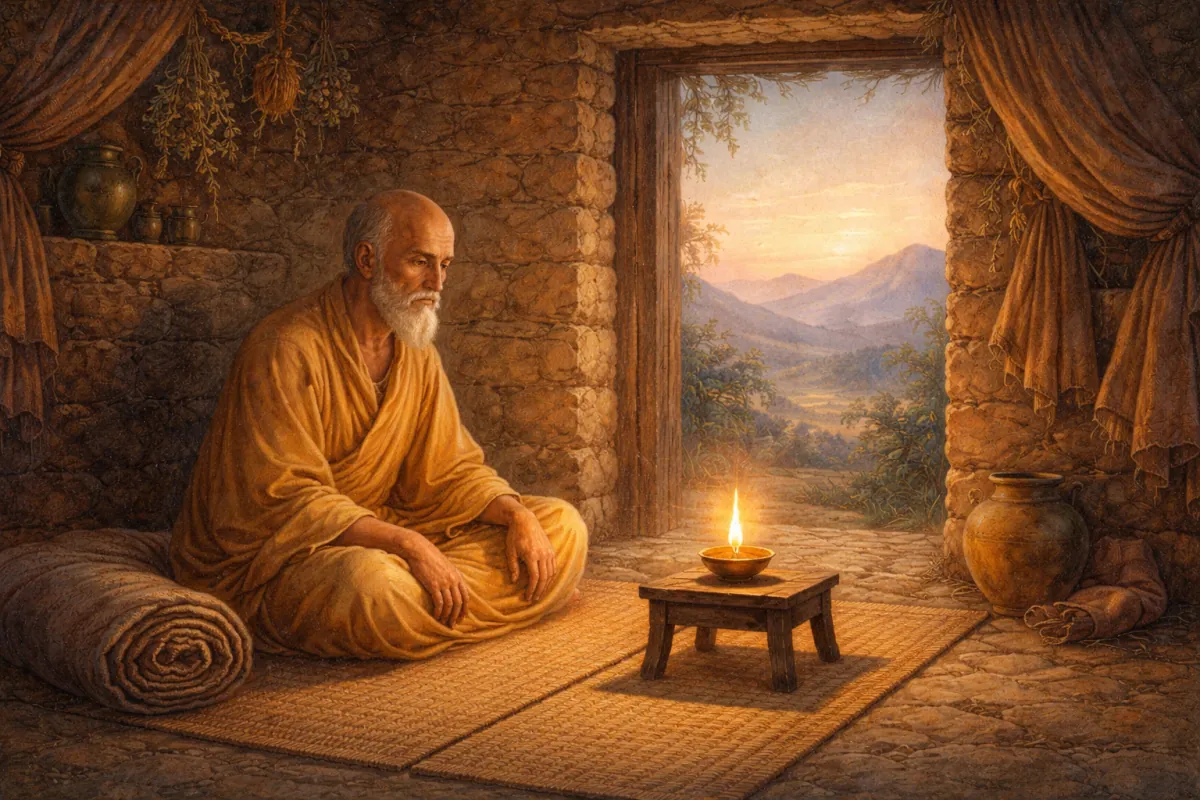
How is the boundless will nurtured? Through deep concentration. The Master personally leads the student, teaching him concentration.
— The Master's Code
1. Definition and Etymology
Dharana (Skt. धारणा) is the sixth limb of the eightfold yoga (Ashtanga Yoga), as expounded by the sage Patanjali in the Yoga Sutras (c. 2nd century BCE – 4th century CE). The term is derived from the Sanskrit root dhṛ (धृ) — "to hold," "to carry," "to support," "to maintain" — and means "holding," "steadfastness," "immovability," or "concentration of the mind."
In the context of yogic practice, dharana is defined as directing and holding the mind's attention on a specific object or point after the withdrawal of the senses from external objects (pratyahara) has been achieved. It is the first of the three internal limbs of yoga (antaranga), which together with meditation (dhyana) and absorption (samadhi) form a single practice of complete control — samyama.
2. Classical Definition in the Yoga Sutras
In the third chapter of the Yoga Sutras (Vibhuti Pada), dedicated to supernatural powers, the sage Patanjali gives a precise definition of concentration:
देशबन्धश्चित्तस्य धारणा ॥३.१॥
Desha-bandhash chittasya dharana
"Concentration is the fixation of consciousness on a specific place."
— Yoga Sutras, III.1
Breakdown of the Sutra's Terms:
Desha* (देश) — "place," "point," "region," "space" Bandha* (बन्ध) — "binding," "fixation," "holding" Chittasya (चित्तस्य) — "of the mind," "of consciousness" (genitive case of chitta*) Dharana* (धारणा) — "concentration," "holding"
According to the Yogabhashya commentary (attributed to the legendary sage Vyasa, but possibly composed by Patanjali himself around 400 CE), objects of concentration can include: the navel center (nabhi-chakra), the heart center (hridaya), the space between the eyebrows (bhru-madhya), the tip of the nose, or any external object.
3. The Place of Dharana in the Ashtanga Yoga System
Patanjali's eightfold yoga is a sequential system of spiritual discipline, where each stage prepares for the next:
External Limbs (Bahiranga):
- Yama — restraints (non-violence, truthfulness, non-stealing, continence, non-possessiveness)
- Niyama — observances (purity, contentment, austerity, self-study, devotion to God)
- Asana — a steady and comfortable posture
- Pranayama — control of breath and prana
- Pratyahara — withdrawal of the senses from objects
Internal Limbs (Antaranga):
- Dharana — concentration of the mind on an object
- Dhyana — an uninterrupted flow of attention
- Samadhi — complete absorption, unity with the object
These last three stages, practiced together, form samyama — total control of consciousness. The Yoga Sutras (III.4) state:
त्रयमेकत्र संयमः
> "The three [together] are samyama"
Mastery of samyama opens the doors to higher knowledge (prajñā) and supernatural powers (siddhis).
4. The Difference Between Dharana, Dhyana, and Samadhi
The great commentator Vachaspati Mishra (9th century CE) and Adi Shankaracharya (788–820 CE) explain the subtle differences between the three internal limbs of yoga:
4.1. Dharana — Fixation
At the level of concentration, the mind is directed toward an object, but the holding is interrupted by distractions. The classical comparison: water dripping from a tap — there are gaps (distractions) between the drops (moments of fixation). The practitioner notices the distraction and returns the mind to the object.
4.2. Dhyana — Uninterrupted Flow
The Yoga Sutras (III.2) define it as:
तत्र प्रत्ययैकतानता ध्यानम्
> "There [in that place], an uninterrupted flow of cognition is meditation"
Meditation is when the drops merge into a single stream. The mind is no longer distracted; attention flows like a stream of oil being poured from a vessel.
4.3. Samadhi — Unity
The Yoga Sutras (III.3) state:
तदेवार्थमात्रनिर्भासं स्वरूपशून्यमिव समाधिः
> "When only the object [of consciousness] shines, as if devoid of its own form, that is samadhi"
In samadhi, the distinction between the meditator, the process of meditation, and the object disappears. Only pure awareness of the object remains, without the interference of subjective perception.
5. Types of Concentration
In traditional texts and the instructions of masters, three main types of concentration are distinguished based on the degree of the object's refinement:
5.1. Sthula-Dharana (Gross Concentration)
Sthula-dharana is concentration on physical, material objects perceived by the sense organs:
A point (bindu*) on a sheet of paper A candle flame (trataka*)
- An image of a sacred symbol
An external image of a deity (murti*)
Practical Guidelines for Sthula-Dharana:
- Adopt the posture of five qualities: legs crossed, hands palms up, back straight, chin slightly tucked, eyes open.
- Do not blink during the practice.
- Do not prevent the natural secretion of tears — this cleanses the eyes and deepens concentration.
- Focus on the object with such sharpness as if threading a needle.
- Hold attention on the object without following thoughts of the past, present, or future.
It is recommended to use a sheet of paper with a dot, placed at a distance of 45 cm at nose level. Begin with 5–10 minutes, gradually increasing the time by 1 minute per day until reaching an hour of practice.
5.2. Sukshma-Dharana (Subtle Concentration)
Sukshma-dharana is concentration on subtle, visualized objects:
The visualized syllable Om* (ॐ) The seed syllable of a chosen deity (bija-mantra*) The full image of a deity (ishta-devata*) Energy centers (chakras*) Points in the subtle body (marmas*)
Methodology for Subtle Concentration:
- Carefully observe the object of concentration (symbol or image of a deity).
- Close your eyes and visualize the image at the level of the eyebrows.
- Imagine the image as golden and hollow inside.
- If the mind becomes agitated, lower the image; if drowsy, raise it higher.
- Start with general features, then move to details — colors, lines, ornaments.
- Do not manipulate the image — changes that arise spontaneously are accepted.
5.3. Shunyata-Dharana (Void Concentration)
Shunyata-dharana or jyotir-dharana (luminous concentration) is concentration on formless objects:
- Thoughtlessness (the gap between thoughts)
- The internal space of consciousness
- The pure light of awareness
The space in front of closed eyes (chidakasha*)
This highest form of concentration requires prior mastery of gross and subtle dharana and leads directly to the experience of dhyana and samadhi.
6. Concentration as the Basis of Contemplation
In the system of Laya Yoga and the teachings of the siddhas, concentration is viewed as the necessary foundation for developing contemplative presence (sahaja-sthiti). The teaching emphasizes that without mastering concentration, it is impossible to reveal deep awareness.
The spiritual path is described as a sequential movement of attention from the periphery to the center:
- External objects — the outermost periphery of consciousness.
Perceptual organs (jñana-indriyas*) — the second level of the periphery. Conceptual mind (manas*) — dualistic "like/dislike" thinking. Intuitive consciousness (buddhi*) — deep awareness. True Self (Atman*) — the center, supreme Consciousness.
Classical sequence of development:
- Concentration — sharp focus on a stationary object.
- Relaxation — transition from tense holding to relaxed presence.
- Awareness in movement — maintaining awareness when thoughts arise.
- Continuous maintenance — integration of contemplation with daily activities.
7. Three Stages of Deepening Contemplation
7.1. Stillness (Shamatha)
The first stage is achieved through concentration on a stationary object. When the mind is fixed on a point or the syllable Om, an experience of stillness arises — the mind becomes like a peaceful ocean.
Three phases of calming the mind:
- Initial phase: The mind is like a mountain river or waterfall — thoughts are agitated even more than usual.
- Middle phase: The mind is like a broad, deep river — the state of stillness becomes stable.
- Final phase: The mind is like a peaceful ocean — deep stillness with light waves on the surface.
7.2. Observing Movement
The second stage is maintaining awareness when thoughts arise. The practitioner observes thoughts like "fish jumping out of a lake," without identifying with them and allowing them to dissolve back into primordial emptiness.
Classical comparison: A thought is a wave; deep awareness is the ocean. Waves cannot stop, but deep down, the ocean is always calm.
7.3. Union with Movement
The third stage is complete integration, where movement and stillness acquire "one taste" (ekarasa). The practitioner does not merely observe thoughts but dwells within the movement of energy itself, while remaining in contemplative presence.
8. Levels of Meditative Absorption (Dhyanas)
The classical text Visuddhimagga ("The Path of Purification") describes in detail the sequential levels of meditative absorption achieved through the development of concentration:
8.1. Access Concentration
The first milestone — when external distractions and waves of thought cease to disturb the focus of attention. The mind still vacillates between the meditation object and thoughts, but one-pointedness predominates.
Signs of access concentration:
- Strong feelings of rapture and happiness.
- A sense of lightness, as if the body is floating in the air.
- Luminous images or flashes of bright light.
- Equanimity toward external stimuli.
8.2. First Dhyana
With prolonged fixation of the mind on the object, a moment comes when superficial consciousness is overcome. The mind "plunges" into the object and remains there motionless.
- Disturbing thoughts disappear completely.
- There is no sensory perception or awareness of the body.
- Physical pain is not felt.
- Rapture, bliss, and one-pointedness prevail.
8.3. Second Dhyana
The mind is freed from all verbal thoughts, even thoughts about the meditation object. Only the reflected image of the object remains as the focus of one-pointedness. Concentration becomes more subtle and stable.
8.4. Third Dhyana
Equanimity arises even toward the highest rapture. Bliss overflows the practitioner and then spreads throughout the body. Without this equanimity, the mind would be pulled back toward the rapture.
8.5. Fourth Dhyana
The complete cessation of bliss and bodily pleasure. Not a single sensation, not a single thought remains. One-pointedness and equanimity reach full strength. Breathing becomes so subtle that the practitioner does not feel its movement.
8.6. Formless Dhyanas (5–8)
The highest levels of absorption go beyond all form:
- Fifth Dhyana — the sphere of Infinite Space.
- Sixth Dhyana — the sphere of Infinite Consciousness.
- Seventh Dhyana — the sphere of Nothingness (Emptiness).
- Eighth Dhyana — the sphere of "neither perception nor non-perception."
In the eighth dhyana, only residual mental processes remain — it is a state of approaching the ultimate limits of perception. As the masters say: "A state so subtle that one cannot say whether it exists or not."
9. Self-Liberation of the Three Gates
The ultimate goal of the practice of concentration and contemplation is to achieve the self-liberation of the three gates (body, speech, and mind) in three types of actions (positive, neutral, and negative).
Practice of Self-Liberation of Thoughts:
- Sitting in contemplation, achieve a state of stillness.
- Allow yourself to think positive thoughts, observing how they dissolve into stillness.
- Then think mundane thoughts, also observing their self-liberation.
- Finally, carefully evoke a negative thought, remaining in awareness, and allow it to return to emptiness.
A similar practice is performed with speech (mantras, ordinary words, inarticulate sounds) and with the actions of the body. When all three levels are self-liberated, the practitioner is said to be "self-liberated from head to toe."
10. Obstacles and Their Overcoming
On the path of concentration, the practitioner faces five classical obstacles (pancha-nivaranas):
- Kamachhanda — sensory desire.
- Vyapada — ill-will, anger.
- Thina-middha — sloth and torpor.
- Uddhacca-kukkucca — restlessness and worry.
- Vicikiccha — doubt.
Methods of Overcoming:
- Restlessness: Relax the body, check for tension in the face and abdomen, perform deep breathing.
- Drowsiness: Strengthen focus, raise the gaze higher, visualize bright light.
- Lethargy: Reflect on the joy and bliss of the practice.
- Doubt: Study texts, consult a teacher, strengthen faith.
11. Practical Recommendations
11.1. Preparation for Practice
According to the Visuddhimagga and the instructions of masters, preparation for intensive concentration practice includes:
- Purification (Vinaya): Observing moral precepts — the foundation for calming the mind.
- Mindfulness: Practicing constant awareness in daily life.
- Right Environment: Associating with like-minded people, avoiding idle chatter.
- Minimal Possessions: Reducing external attachments.
- Moderation in Food: Enough for health, but not causing drowsiness.
- Solitary Place: Away from noise and distractions.
11.2. The "Triangular Concentration" Technique
A special method for beginners with a scattered mind:
- Imagine any mental movements and perceptions of the world as the base of a triangle.
The third point of the triangle is the object of concentration (the syllable Om* or a point).
- Strive to collapse all the diversity of perception into this single point.
- Practice as if nothing else exists except this point.
11.3. Time Benchmarks
Traditional instructions indicate approximate timeframes for serious practitioners:
- 6 months of daily gross concentration — appearance of the first stable results.
- 6 years — gaining an understanding of what it means to abide in presence; achieving self-liberation of the three gates.
- 12 additional years — stabilization of presence that can no longer be lost.
- A lifetime — working with the subtlest methods for the complete purification of the causal body.
12. Levels of Concentration in Everyday Life
Concentration is applicable not only in formal meditation but also in daily activities. Traditional teachings distinguish eight levels of concentration:
- Weak desire — dreams and fantasies without real focus.
- Strong desire without concentration — many thoughts, but they do not materialize.
- Intention to concentrate — the birth of concentration, but the will is still weak.
- Variable concentration — sometimes good, sometimes weak; success depends on chance.
- Ordinary good focus — stable achievement of goals, intuitiveness.
- One-pointed strong focus — clear-knowing, magical control of the will.
- Concentration penetrating the future — willful control of causes and effects.
- Concentration changing reality — the level of an avatar, complete unity with the Divine will.
13. Concentration and Service
It is important to understand that concentration is not only a practice in the lotus position with eyes closed. This quality should permeate the practitioner's entire life:
"If you do seva (service) in concentration, your seva will be easy and successful, you are not distracted by anything. This is just like sitting and concentrating on a point or the image of a deity. These are the same processes."
Service (seva) becomes a full practice of concentration when performed with complete attention and one-pointedness. In this case, the mechanisms of consciousness are identical to formal meditation.
Conclusion
Dharana — the sixth limb of Patanjali's classical yoga — is the key practice linking external yoga (bahiranga) with internal yoga (antaranga). It is the foundation upon which all subsequent achievements are built: meditation, samadhi, and ultimately, liberation (moksha).
Spiritual experience, the ability to meditate and contemplate, the ability to achieve goals in life — all of this directly depends on the ability to focus. As the tradition says:
"In the end, the mind will be concentrated on the Atman. This is dharana — the stage at which tremendous attention must be developed."
Concentration is the tool with which the scattered rays of the mind are gathered into a single, powerful stream capable of penetrating the essence of reality and revealing the higher Self (Atman).
Sources and Literature
Classical Texts:
Yoga Sutras* of Patanjali (c. 2nd century BCE – 4th century CE) Yogabhashya* — commentary on the Yoga Sutras (c. 400 CE) Visuddhimagga* ("The Path of Purification") — Buddhist treatise by Buddhaghosa (5th century CE) Tattva Vaisharadi* — commentary by Vachaspati Mishra (9th century CE) Hatha Yoga Pradipika* by Svatmarama (15th century)
Modern Research:
Edwin F. Bryant, The Yoga Sūtras of Patañjali* (North Point Press, 2009) Georg Feuerstein, The Yoga-Sūtra of Patañjali* (Inner Traditions, 1989) Philipp A. Maas, Samādhipāda: Das erste Kapitel des Pātañjalayogaśāstra* (Aachen, 2006) Gregor Maehle, Ashtanga Yoga: Practice and Philosophy* (New World Library, 2006)
