

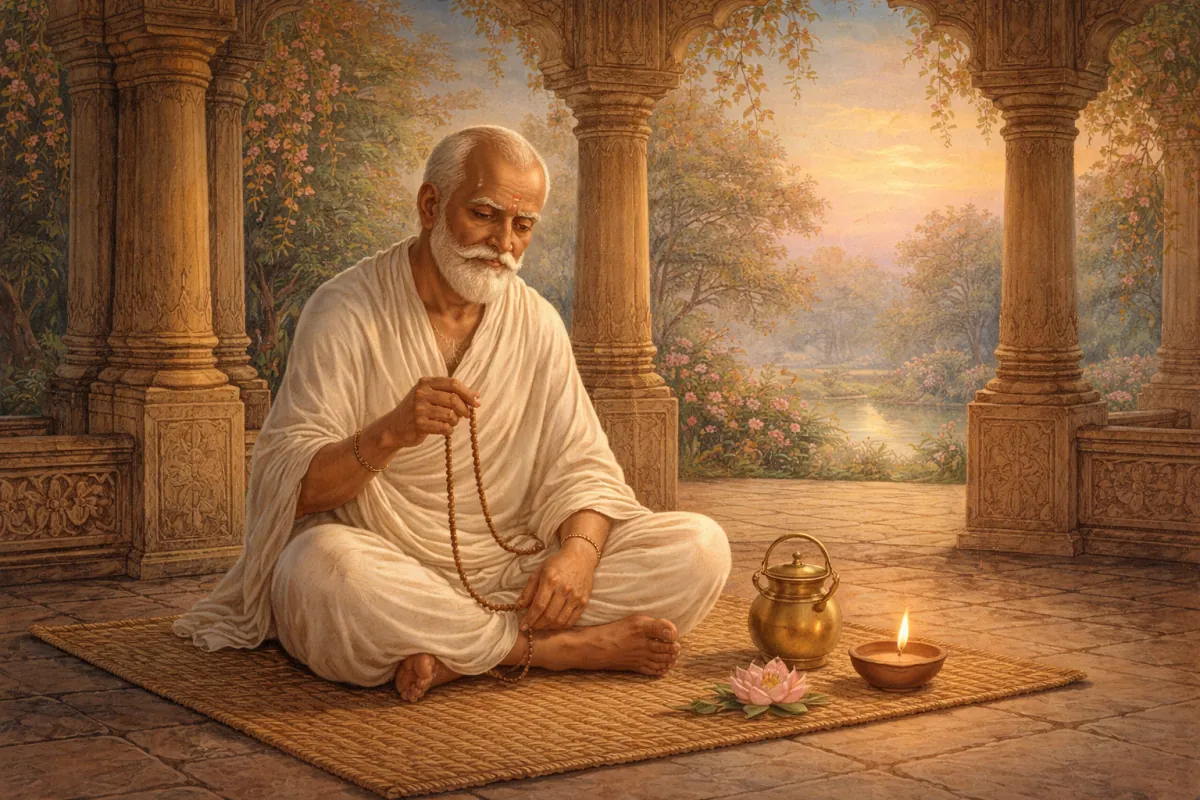
In the tradition of Sanatana Dharma, there is a practice known as the "path for the Kali Yuga"—accessible to all, requiring minimum external conditions, yet leading to the most profound goal: union with God. This is japa (Skt. japa)—the focused repetition of a mantra.
What is a Mantra?
The word mantra (Skt. mantra) is formed from two roots: man—"mind," "to think"—and tra—"protection," "instrument." Literally: "that which protects the mind" or "an instrument of the mind." There is also a second interpretation: from manana ("to contemplate continuously") and trāyate ("to liberate"). Thus, a mantra is "that which liberates the one who meditates upon it."
According to the Vedic tradition, mantras were not composed by humans. The Rishis—seers of deep antiquity—"saw" them in a state of highest contemplation. Therefore, they belong to shruti (Skt. śruti, "that which is heard"): direct perception from the source. Rishis like Vishvamitra, Vasishtha, and Yajnavalkya passed these sound formulas to their disciples—this is how the lineages of transmission, paramparas (Skt. paramparā), which have reached our days, were formed.
In every mantra, three elements are present: the rishi (the discovering sage), the devata (the deity associated with the specific sound), and the chandas (the metrical meter). Together they constitute the "life" of the mantra—its consciousness, which in Sanskrit is called mantra-chaitanya (mantra-caitanya).
The Nature of Mantra: The Sphota-vada Doctrine
To understand why the repetition of a mantra produces a real effect, one must turn to the tantric concept of sphota-vada (Skt. sphoṭa-vāda)—the doctrine of vibration.
According to this teaching, the entire universe is nothing but the unfolding of vibrations at different levels. The subtlest are associated with pure consciousness and bhava (inner attunement). Coarser ones are the vibrations of thoughts and emotions. Even coarser are physical and material vibrations. Depending on their karma, living beings are attracted to vibrations akin to them and live in the world that corresponds to the frequency of their consciousness.
A mantra is a vibration imbued with semantic meaning that points to a specific spiritual reality. When a practitioner utters a mantra, they generate the sound body of that reality. The vibrations gradually spread through the subtle energy body, purifying it. The deeper the concentration, the more complete the impact.
The result is not determined solely by the number of repetitions. The Guru explains that if one reads a mantra without distraction, with awareness of the bhava and the meaning of each syllable, purification always occurs. One mantra recited with full presence acts differently than a hundred recited "by inertia."
What is Japa?
The word japa (Skt. japa) comes from the root jap—"to repeat in a whisper," "to mutter." In a spiritual context, it is the focused, systematic repetition of a mantra or a name of God with a specific inner attitude.
The status of japa in the tradition is highlighted by a verse from the Bhagavad Gita (Chapter 10, Verse 25), where Krishna says:
"Of sacrifices, I am the sacrifice of japa."
— Bhagavad Gita, 10.25
Japa is a sacrifice of the mind. Not an external offering of flowers or fire, but the offering of attention itself at the feet of Ishvara.
Japa and dhyana (Skt. dhyāna, meditation) are described in the tradition as inseparable. When the name of Rama or Krishna is uttered, the image of that deity rises before the inner eye. The name (Skt. nāma) and the form (Skt. rūpa) are inseparable. Therefore, japa is simultaneously repetition and meditation: one practice does not exist without the other. In the beginning, they go together; as it deepens, japa gradually falls away—leaving only pure meditation.
Types of Japa
The tradition distinguishes several ways of performing japa based on the method of pronunciation.
Vaikhari-japa (Skt. vaikharī-japa)—japa aloud, in a full voice. The sound holds the attention, making it easier to direct the mind toward the object of practice. It is recommended to start with this type.
Upamshu-japa (Skt. upāṃśu-japa)—whispered, with only the movement of the lips. According to traditional assessments, it exceeds the power of vaikhari a thousand times, as it requires subtler concentration.
Manasika-japa (Skt. mānasika-japa)—mental japa, without the involvement of the speech organs. The most effective type, and the most difficult: without the support of sound, the mind quickly disperses. One transitions to mental japa gradually.
Likhita-japa (Skt. likhita-japa)—written. The practitioner writes the mantra many times by hand while maintaining concentration. It is well-suited for those whose minds are difficult to quiet using conventional methods.
Types of Mantras
Bija-mantras (Skt. bīja-mantra)—"seed" syllables: Om, Hrim, Shrim, Klim, and others. They are not translated directly—they act through vibration rather than a semantic image. Om (pranava) is the primordial sound of the universe, the vibration of Brahman as such.
"Japa of the mantra Om has a tremendous effect on the mind. Uttered in the correct way, it awakens and transforms every atom in the physical body, generates new vibrations, and awakens spiritual power."
— "Japa Yoga," Swami Sivananda
Nama-mantras—mantras containing the names of specific deities. "Namah Shivaya" (na-ma-śi-vā-ya)—five syllables corresponding to the five elements; "Hare Krishna"; "Om Namo Narayanaya." These mantras carry a double impact: vibration and figurative contact with the Ishta-devata.
Vedic Mantras—mantras from the corpus of the four Vedas. The most famous is the Gayatri Mantra (Rigveda III.62.10):
Om bhur bhuvah suvah
tat savitur varenyam
bhargo devasya dhimahi
dhiyo yo nah prachodayat
"We meditate on the worthy radiance of God Savitar. May He direct our minds."
Finally, tantric mantras—transmitted strictly through initiation. These include the mantras of Kashmiri Shaivism, Shakta Tantra, and other lineages of Sanatana Dharma.
Conditions of Practice: Diksha and Samaya
A mantra is not just a sequence of sounds. It contains consciousness (mantra-chaitanya) and power (mantra-shakti). For them to be revealed, they must be "unlocked"—and this is exactly what happens during diksha (Skt. dīkṣā), initiation from a Guru within a living parampara. Without diksha, a mantra remains merely sound vibrations: the rishi of the mantra does not recognize the practitioner, and the devata does not respond.
Swami Vishnudevananda Giri explains it this way:
"A mantra is the sound body of a deity; it contains a rishi, it contains a devata. If the devata does not appear, if the rishi does not appear, there is no benefit from the mantra. And how will they appear? Because we received the transmission from the Guru in samaya, being disciples."
— Swami Vishnudevananda Giri, lecture "Five Treasures and Eight Protections," 2018
Besides diksha, the practice rests on samaya (Skt. samaya)—a system of vows and obligations to the tradition and the Guru. Samaya requires continuous daily practice. If the practice is interrupted for a long time, the connection weakens. A mantra received during diksha should not be disclosed to others: kept in secret, it gains strength.
Technique of Execution
Time. Preferably brahma-muhurta (Skt. brahma-muhūrta), the period one and a half hours before sunrise. The mind is not yet burdened by daily impressions, and the external atmosphere is quiet. Sadhana should be performed regularly, at the same time—without skipping.
Place. One permanent place by the home altar. Facing east or north.
Tools. To count repetitions—a mala (Skt. mālā), a rosary of 108 beads. The number 108 is found in all major traditions of India: it reflects the ratio of the sun's diameter to the distance between the Earth and the Sun, as well as the number of names of Shiva and Vishnu in canonical texts.
Bhava. Bhava—inner attunement, spiritual mood—is more important than technique. Japa is performed with awareness of the presence of the Ishta-devata, with faith (shraddha, Skt. śraddhā) and love (prema, Skt. premā). Mechanical repetition without bhava is, as the tradition says, "like a parrot repeating names without understanding."
Norm. After receiving diksha—a minimum of eight repetitions of each mantra per day to maintain samaya. A full practice ranges from one round of the mala (108 repetitions) to sixteen or more, according to the Guru's instructions.
Fruits of Practice (Phala)
At the level of the mind—gradual pacification. A mind attached to the mantra is less and less captured by random thoughts and is held more steadily in presence. Like water wearing away a stone drop by drop, the repetition of a mantra dissolves samskaras (Skt. saṃskāra)—subconscious imprints of past actions.
At the level of the subtle body—restructuring of the vibrational field. Different mantras work with different levels: a mantra associated with the sahasrara acts differently than a mantra for the heart center. This is not a metaphor but a description of concrete experience confirmed in lineages of transmission over millennia.
At the level of spiritual life—establishing a connection with the Ishta-devata and the parampara. The practice of japa gradually transitions into meditation; meditation into contemplation. The tradition describes the final fruit as samadhi (Skt. samādhi)—union with God.
Practice
The practice of japa is part of pancha-nitya-karma (Skt. pañca-nitya-karma)—the five daily practices. It is not an option or an addition to the "main" practice. It is the foundation.
The Guru has repeatedly pointed out that concentration, japa, and meditation are steps of the same ladder:
"One must practice mantra, japa, one must develop awareness, cultivate sakshi (the witness), inner awareness. From concentration, gradually transition to meditation."
— Swami Vishnudevananda Giri, lecture "The Path to Eternal Happiness through Subduing the Mind," 2017
The Ishta-devata—the personal deity with whom the practitioner establishes a connection through the mantra—plays a vital role. It is with the Ishta-devata that the specific mantra received during diksha is connected. This connection is a living interaction between the practitioner and the spiritual reality standing behind the sound.
Japa is simple in form—and inexhaustible in depth. It is this combination that makes it a practice for the Kali Yuga: it requires no special physical attributes, secluded ashram, or years of preliminary preparation. It requires consistency, bhava, and—fundamentally—a living connection with the tradition through diksha.
For those who do not yet have initiation, the tradition recommends starting with pranava-japa—repetition of the syllable Om—and the study of sacred texts. For those who have already received diksha: practice every day, without skipping, at the same time, with faith and presence.
The mantra reveals its own secrets—but only to the one who does not rush this revelation.
