

You know how to love. At least, you think you do. But what if the love you call love is merely a shadow of the authentic? Attachment to loved ones, warmth toward those who are pleasant, indulgence toward those who are useful—and a wall of alienation toward everything else. This is not the love of a yogi. This is the love of the ego—conditional, selective, and depletable.
Sanatana Dharma knows a different kind of love. Boundless. Patanjali describes it in the thirty-third sutra of the first book of the Yoga Sutras. He lists four qualities of the mind: maitrī, karuṇā, muditā, upekṣā—loving-kindness, compassion, sympathetic joy, and equanimity. Developed to infinity, they clarify consciousness—citta-prasādanam—and open the path to samadhi.
These four states are called the Brahma-viharas (Skt. brahma-vihāra)—the "Abodes of Brahma," states in which the beings of the higher worlds abide. They are the very nature of consciousness purified of the kleshas. They are already within you. They always have been. Your practice is not to create them, but to uncover them.
What are the Brahma-viharas
The word vihāra means "abode" or "that in which one dwells." Brahma is not just the creator god, but the supreme quality belonging to worlds beyond gross karma. In the Hindu tradition, these are the states of the gods of Svarga-loka and Mahar-loka—beings who have completely purified themselves and achieved perfection in love, compassion, joy, and equanimity.
The Brahma-viharas are not a "meditation for beginners." They are a description of what a liberated mind looks like from the inside. When the kleshas dissolve—not their residue, not emptiness—it is precisely these four states that are revealed as the foundation of consciousness.
Patanjali places this sutra in the Samadhi Pada—the book about the nature of consciousness and methods for its clarification. The Four Infinites are not a preparation for practice. They are the practice itself.
Maitri — Loving-kindness
Maitrī comes from the root mitra—"friend," "ally," "one who wishes well." Maitri is benevolence that does not depend on anything external. Neither on the behavior of another, nor on their position, nor on how they treat you.
Wherein lies the difficulty? An ordinary person loves those who are close to them, those who fit their image of the world. When these conditions change, their love changes as well. This is not the person's fault. It is the nature of the unillumined mind—to cling to the pleasant and reject the unpleasant. Just as a magnet attracts certain objects and repels others, the ego constructs the world according to the principle of "ours" and "others."
Maitri is a complete reversal of this mechanism.
"When you love someone, what do you love?" the Guru asks. "Do you love the body? It will change. Do you love the mind? It also changes over the years. Do you love the prana? Energy can run dry. You love a given divine manifestation. And then you can love this manifestation of divinity in everyone, in everything."
Here is the key. If you love not the personality, not the body, not a convenient image of the other, but the Brahman who manifests through that person—your love becomes inexhaustible. Brahman does not change. Brahman does not betray. Brahman is the same in every being—in the near and the far, in the pleasant and the unpleasant.
Develop maitri gradually. First, toward yourself. Then, toward those dear to you. Then, toward strangers. Then, toward those with whom you have tension. Finally, toward all beings without exception. Do not rush. This is not an affirmation. This is real work with the mind.
The obstacle to maitri is selectivity. As long as your benevolence ends where "others" begin, it is not maitri. Maitri knows no "us" and "them."
Karuna — Compassion
Karuṇā is the "trembling of the heart," the "response to another's pain." In the Sanatana Dharma tradition, compassion is directed toward all beings dwelling in suffering—and it is never selective.
Karuna is not pity. Pity places you above the sufferer: you look down on them, you feel "sorry" for them, you feel better, healthier, luckier. This is a subtle form of pride. Karuna does not elevate you above the other. It meets the other exactly where they are—and wishes for their release from suffering.
Karuna is also not "compassion fatigue." Many think that compassion means carrying the pain of others within oneself, absorbing it, and being exhausted by it. No. Sustainable karuna is not depleted—it is fed from an infinite source. Just as a lamp is not diminished by lighting other lamps, compassion born from the understanding of Brahman in everything does not exhaust, but saturates.
The Devikalottara Agama states:
"Let the seeker of liberation act selflessly, perform good deeds, and provide help to all."
This is a direct consequence of understanding the unity of all existence.
Ask yourself a direct question: is there even one living being for whom you cannot feel compassion? If there is—that is where the work lies.
The obstacle to karuna is sentimentality. When another's grief overwhelms you completely and you lose your stability—that is not karuna, that is a klesha. True compassion remains firm. It sees the pain, does not close itself off from it—and does not drown in it.
Mudita — Sympathetic Joy
Muditā is "joy," "exultation." But it is a joy of a special kind: it is the joy you feel when others are happy.
This is the most unexpected of the four states—and the most revealing. For it is here that the true quality of the mind is exposed. The ordinary mind compares. Another's success triggers anxiety: "What about me? Why them and not me?" Envy, competition, subtle irritation at another's prosperity—all these are signs of a mind stuck in a sense of separateness.
Mudita completely flips this logic. Another's happiness becomes your happiness. Another's success becomes your joy. Because you begin to see: all beings are manifestations of the one Brahman, and the joy of any one of them is the blossoming of the very same reality from which you are woven.
Like a listener who rejoices in the music of another musician as sincerely as if they were playing themselves—a yogi established in mudita rejoices in another's well-being without a shadow of possessiveness.
Swami Vishnudevananda Giri speaks of this directly:
"As you wish, but you must learn to love, you must learn to have compassion, you must learn to rejoice for others."
This is not a piece of advice. It is a requirement of the path.
Develop mudita through specific people. Think of someone close to you who is doing well. Allow yourself to feel sincere joy for them. Then, someone neutral. Then, someone with whom you have tension. Rejoicing in the success of a person you do not like—that is already true mudita.
The obstacle to sympathetic joy is envy and competition. As long as you are competing, sympathetic joy is closed to you. The door opens only when you truly feel that you have nothing to lose from another's happiness.
Upeksha — Equanimity
Upekṣā is "even vision," "imperturbability," "impartiality." This is the fourth and most subtle of the states—the pinnacle of the previous three.
Patanjali links upeksha with apuṇya—that which is not virtuous. Upeksha is directed toward the deluded, toward those who cause harm, toward those you are inclined to judge. Here the mind undergoes its most difficult test: neither to turn away nor to become entangled.
Upeksha is not indifference. Indifference is passive, cold, and defensive. "I don't care" is not upeksha; it is closedness. Upeksha is a vivid, stable presence that yields neither to judgment nor to involvement. It sees everything—and remains even.
"Impartiality means looking equally upon poverty and wealth, joy and suffering," — Swami Vishnudevananda Giri.
To look equally upon those close to you and those far away, viewing all as your mothers or as your children. When we have such an even and equanimous vision of everything, we can say that we are very close to contemplative presence.
Upeksha is the maturity of practice. It appears when the three previous states have become stable—and now you do not lose them when encountering what used to throw you off balance. Anger, injustice, another's vice, someone's cruelty—none of this sweeps you away anymore. You see. You are present. You do not react.
In the tradition of Laya Yoga, upeksha is described as a transition to pure vision. Gradually exercising in contemplation, the practitioner moves toward equanimity, which allows them to accept even the darkest phenomena without damage to their life force or consciousness.
The obstacle to upeksha is judgment. As long as you are actively reacting to the vices of others, upeksha is inaccessible. This does not mean tolerating evil. It means acting, if necessary, but from within a stable, unclouded state.
Meditation Technique
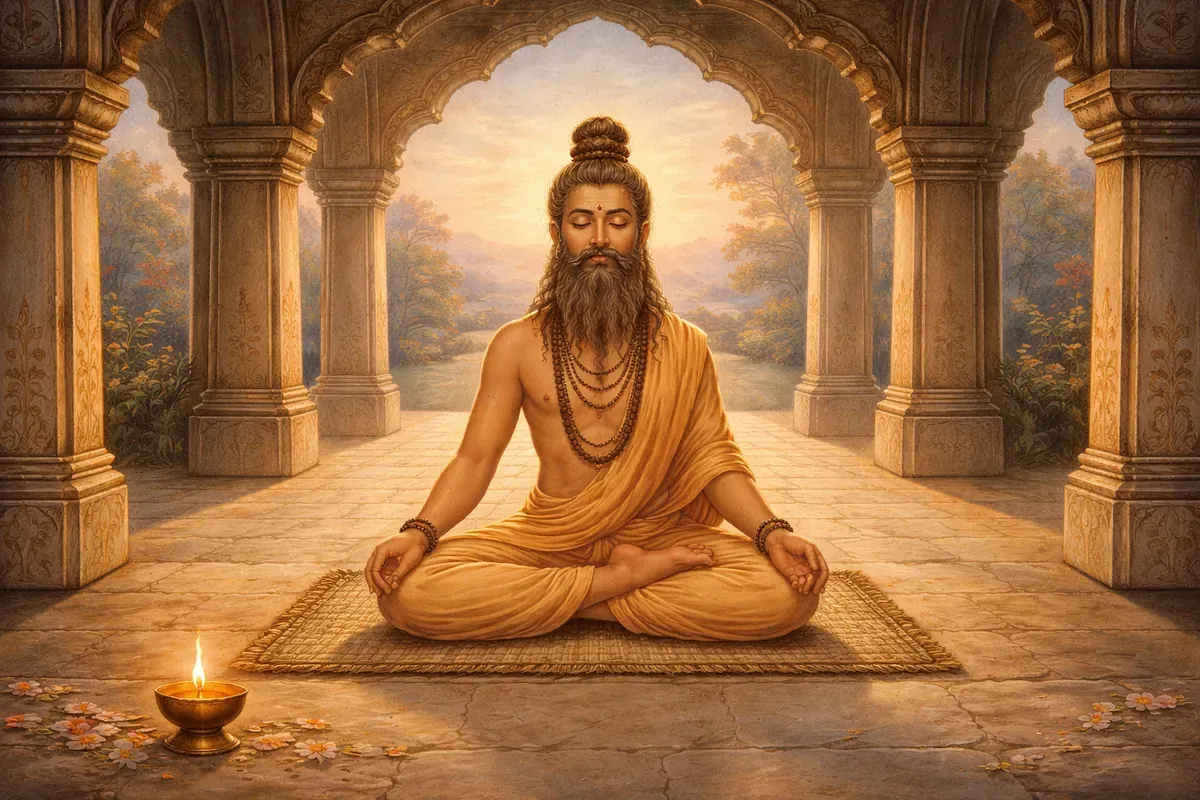
The practice of the Four Infinites does not require special conditions. Silence, a stable posture, and a readiness to direct the mind inward—this is enough. Dedicate at least twenty to thirty minutes to it.
Preparation. Take a stable meditation posture. Close your eyes. Observe your breath for a few minutes—not controlling it, simply being present. Let gross thoughts subside. When the mind settles a little, move to the practice.
Stage One — Maitri (Love). Direct your attention to the heart area. Feel warmth there—or simply imagine it. Mentally wish happiness first to yourself: "May I be happy. May I be free from suffering." Let this wish fill you—do not rush. Then expand it to loved ones. Then, to neutral people. Then, to those toward whom you feel tension or resentment. Finally, to all living beings in all worlds: "May all beings be happy. May all beings be free from suffering."
Stage Two — Karuna (Compassion). Remember or imagine a being who is suffering right now. Let the heart respond—not by sinking into the pain, but by directing an active wish toward them: "May this being be free from suffering." Expand this wish gradually to all the suffering in the world, in all dimensions of existence.
Stage Three — Mudita (Sympathetic Joy). Remember or imagine a being who is rejoicing, prospering, dwelling in happiness. Rejoice with them—sincerely, without a shadow of envy: "May this happiness continue. May it never run dry." Expand the joy to everyone who is doing well at this moment.
Stage Four — Upeksha (Equanimity). Bring the mind to complete stillness. Observe everything—suffering and joy, virtue and delusion—with an even, steady gaze. Nothing disturbs. Nothing involves. You are simply present—encompassing everything with an even, unclouded state. Hold it for as long as you can.
Completion. Dedicate the merit: "May the merit of my practice serve the welfare of all living beings." Slowly return your attention to your breath and body.
Practice daily for the first few months. These states need to become habitual—so that you can easily summon them, like flipping a switch. Swami Vishnudevananda Giri says exactly this: "When the primary wave of anger arises, we immediately remember, and the Four Infinites extinguish this wave. It is as if we have a switch inside that allows us, by pressing a button, to change the state of the soul."
Where this practice leads
A yogi established in the Four Infinites changes the space simply by their presence. People in their presence soften. Evil thoughts depart. Hearts open. Discords subside. This is not a beautiful metaphor. It is the real action of a purified consciousness—a state transmitted not by words, but by the very nature of presence.
But this is only the external sign. The main thing is inside.
When deeply rooted, the Four Infinites become pure vision—śuddha-dṛṣṭi. You begin to perceive all beings and all phenomena directly in their true nature—without the polluting projections of attachment and aversion. Pure vision is not a separate practice; it is that into which the four infinites organically flow. The gate to contemplative presence.
"Ultimately, you must extend your love to the entire universe,"
Swami Vishnudevananda Giri
The Guru continues: "And the Four Infinites, which we perform every evening in the monastery, are precisely an attempt to transform one's human love into love for the entire universe. That is why they are called the Four Infinite States of Brahma."
This is the goal. A complete transformation of love—from personal, conditional, and limited into boundless love, like the consciousness of Brahman itself.
A yogi should always be friendly, kind-hearted, loving, compassionate, and equanimous within—no matter what trials arise on the path. This is the essence of the Four Infinites. It is not a technique. It is a way of being.
Start today. Do it every day. When the Four Infinites take root—you will notice it not by the sensations on the mat, but by how your mind changes beyond it.
