

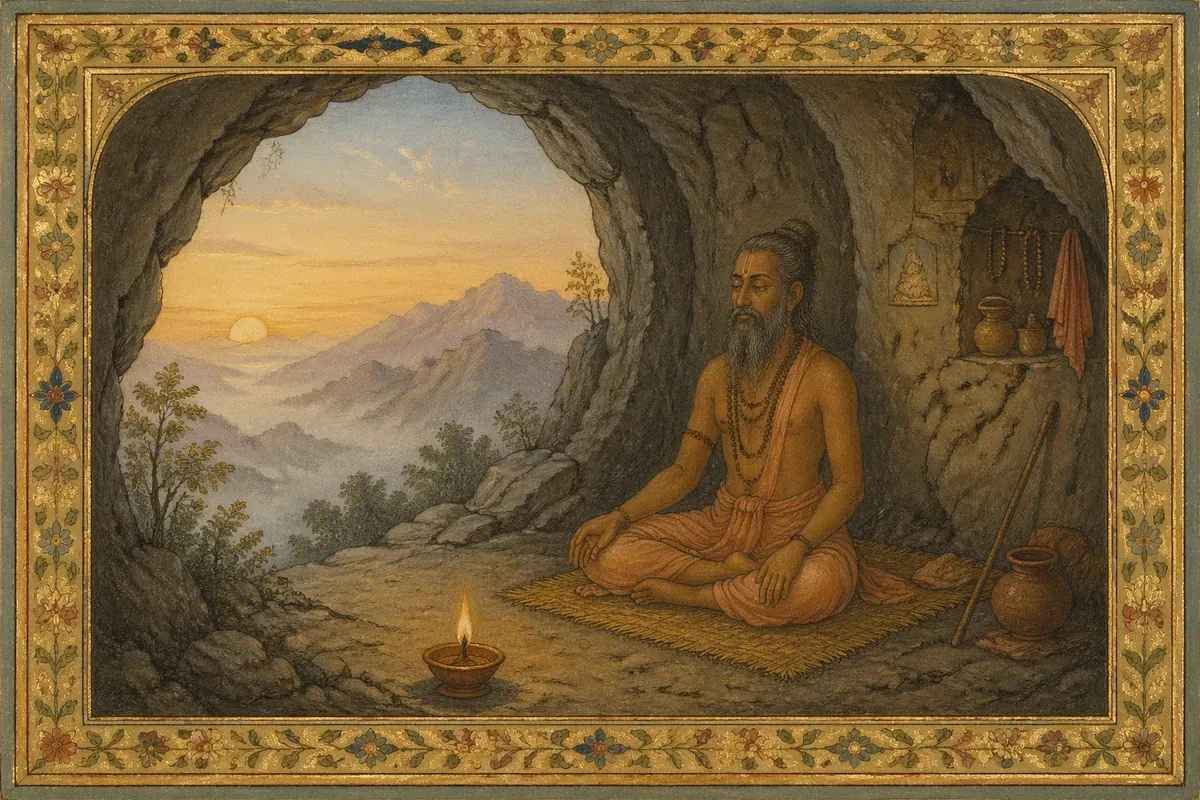
The word sadhana is often translated simply as "spiritual practice" — and immediately reduced to a set of morning exercises or a week-long meditation course. In the Sanatana Dharma tradition, this term carries a fundamentally different meaning: it refers to a systemic discipline that encompasses the practitioner's entire life and is directed toward a single goal — liberation from the cycle of samsara.
What is Sadhana
Sadhana (Skt. sādhanā) comes from the verbal root sādh: "to achieve," "to accomplish," "to bring to completion." In a broad sense, the word denotes any purposeful spiritual effort; in the traditional sense, it refers to a stable system of practices adopted by a student in accordance with the Teacher's instructions and the lineage of transmission.
Sadhana is broader than any meditative technique or set of asanas. According to the teachings of the tradition, it is a process of infinite purification of consciousness from layers of ignorance, rather than the creation of something fundamentally new. The practitioner does not "build" spiritual achievements: they remove what obscures the initially pure nature of the Atman.
The word sadhu — one who performs sadhana — shares the same root: "one who goes toward the goal," "one who achieves." In the name itself, the tradition has solidified the connection between the practitioner and the practice as a single process of transformation.
Three Types of Sadhana
The Shastras describe three basic types of sadhana that encompass all the spiritual work of a practitioner.
Nitya-sadhana (Skt. nitya — constant, eternal) is a practice performed every day throughout one's entire life, without exception. It does not change depending on circumstances and forms the foundation of spiritual life.
Naimittika-sadhana (Skt. naimittika — occasional) is a practice tied to special days of the spiritual calendar: Ekadashi, festivals of the Shaivite tradition, or commemoration days of the lineage teachers. It complements nitya-sadhana and creates the rhythm of the spiritual year.
Kamya-sadhana (Skt. kāmya — desired) is a practice performed at one's own discretion for the sake of intensified spiritual growth: special pujas, intensive courses, or specific mantra-sadhanas. Its volume and nature are determined by the Teacher according to the student's level.
Alongside these three, a fourth level is specially highlighted — sahaja-sadhana (Skt. sahaja — natural, innate). It cannot be described by a schedule or technique — only by continuous presence in awareness, abiding in God regardless of the activities of the body, speech, and mind. Nitya-sadhana and dina-sadhana create the ground for this presence; sahaja-sadhana is its highest expression.
"You have three types of sadhana: nitya, naimittika, and kamya. Just do it. And there is a fourth, which runs like a red thread through everything — sahaja-sadhana: the path of a single samaya, continuous contemplation, and awareness."
— Swami Vishnudevananda Giri
Nitya-sadhana — Daily Mandatory Rituals
Nitya-sadhana is the continuous pillar of spiritual life. According to the tradition, its absence leads to the accumulation of prativayu-dosha — a karmic flaw resulting from a broken connection with the lineage of transmission.
The structure of nitya-sadhana includes: sandhya-upasana — the ritual invocation of grace during three special periods of the day when prana fills the central channel (at dawn, noon, and sunset); japa — the daily chanting of the mantra given by the Teacher; puja — simple worship of Shiva or a chosen Ishta-devata; guru-yoga — meditative union with the consciousness of the Teacher and the lineage.
Agamic texts describe the path of practice sequentially:
"It should be known that the efforts of yogic realization are traversed by yogis in eight stages: yama, niyama, asana, pranayama, pratyahara, dharana, dhyana, and samadhi."
— Suprabheda Agama
Yamas and niyamas are the foundation, without which other elements of practice lose their stability. Nitya-sadhana embodies precisely this stability: its value lies not in the mystical experience of a single morning, but in the continuity built over years.
Nitya-sadhana does not remain frozen once chosen. As spiritual growth occurs, it deepens: japa is enriched with visualization, sandhya-upasana moves into subtler states, and puja acquires greater ritual completeness. The main criterion is not volume, but depth.
Dina-sadhana — Daily Yogic Practice
Dina-sadhana (Skt. dina — day) is a daily practice whose content changes depending on the level of training, received transmissions, and the stage of the spiritual path. Nitya-sadhana remains the unchanging foundation; dina-sadhana adapts.
Depending on which practice the student has been initiated into, dina-sadhana includes Kundalini yoga, Shat-chakra yoga, Mahashanti meditation, Laya yoga practices, and contemplative sankalpas. This is practice according to a schedule, corresponding to the current level and received transmissions.
The difference between the two types is fundamental. Nitya-sadhana is related to constant practice in this life; dina-sadhana changes depending on place, time, and circumstances. The former continues until full liberation, while the latter transforms as the practice grows and deepens.
Retreat as a Form of Tapas
Tapas (Skt. tapas — heat, austerity) refers to purposeful efforts that go beyond the usual comfort zone for the sake of spiritual purification. A retreat is a traditional form of tapas in which the practitioner withdraws from worldly obligations for a certain period to fully immerse themselves in sadhana.
A retreat is not an alternative to daily practice, but its continuation. One should not start with great tapas: first, the daily discipline of nitya-sadhana is cultivated, and only then, as the senses are purified, does the practitioner move to retreat formats — three-day, seven-day, or monthly.
The condition of a retreat alone does not awaken motivation. Motivation is nurtured by daily practice. A retreat only intensifies what is already there. Therefore, in the Sanatana Dharma tradition, monthly retreats are provided for karma-sannyasis as a form of maintaining sadhana-vritti — a steady habit of practice.
In the teachings, a retreat is a condition for receiving certain transmissions and experiencing samadhi. Those who undergo long retreats touch states inaccessible in everyday life. However, this is only a step: the goal is continuous contemplative presence not only in retreat but in all situations.
Fruits of Sadhana: Purification and Liberation
The goal of sadhana in the Sanatana Dharma tradition is not special experiences or psychological states, but the gradual purification of consciousness: the washing away of karmas, the development of viveka (discriminative wisdom), and vairagya (detachment). From the perspective of energy, sadhana is the continuous increase of atma-shakti, the inner power of the spiritual Self, until it equals the limiting power of maya.
Sadhana accelerates evolution: the practitioner goes against the usual flow of karma. Accumulated karmas are activated and gradually burned in the fire of tapas. This process can be difficult. But it is precisely what reveals new facets of consciousness and, over time, turns inner spiritual experience into the best guide — the Sadguru within.
The tradition distinguishes clearly: sadhana is not introspection or reflection on one's experiences. Sadhana is self-transcendence. It is opening oneself to the light of primordial Wisdom, under which the false "I" gradually dissolves.
The Role of the Teacher and Lineage
Sadhana is rooted in tradition. Without a living lineage of transmission (parampara), practice risks becoming formal amateurism. This is why all shastras repeat: before proceeding to sadhana, one should find their teaching, their Teacher, and receive their blessing.
The Teacher's role is twofold. First, they transmit specific methods: mantras, the structure of nitya- and dina-sadhana, and indications of the student's spiritual status. Second, they are the living embodiment of the path. Scriptures act as a map; the Teacher is a guide who knows the way because they have walked it themselves.
Hence the practical conclusion: the content of sadhana is not chosen arbitrarily. It is transmitted from stage to stage, in accordance with the student's spiritual maturity (adhikara).
In the Sanatana Dharma tradition transmitted by Swami Vishnudevananda Giri, sadhana is the totality of all upayas (methods) leading to liberation. It includes the study of sacred texts (shravana), deep reflection on the teaching (manana), and continuous contemplation (nididhyasana).
Nitya-sadhana, dina-sadhana, and retreat are three levels of a single movement: from external discipline to internal presence, from regular effort to natural abiding in God. Nitya-sadhana is connected with the eight avaranas — protective coverings that shield the practitioner from impure influences and maintain a constant flow of grace from the lineage.
"To find your teaching, your method, and to apply it — that is what is called sadhana."
— Swami Vishnudevananda Giri
Sadhana performed every day throughout one's life is not a burden. It is a protection. And it is precisely what provides the most concrete answer to the question every practitioner eventually asks: what exactly to do on this path.
