

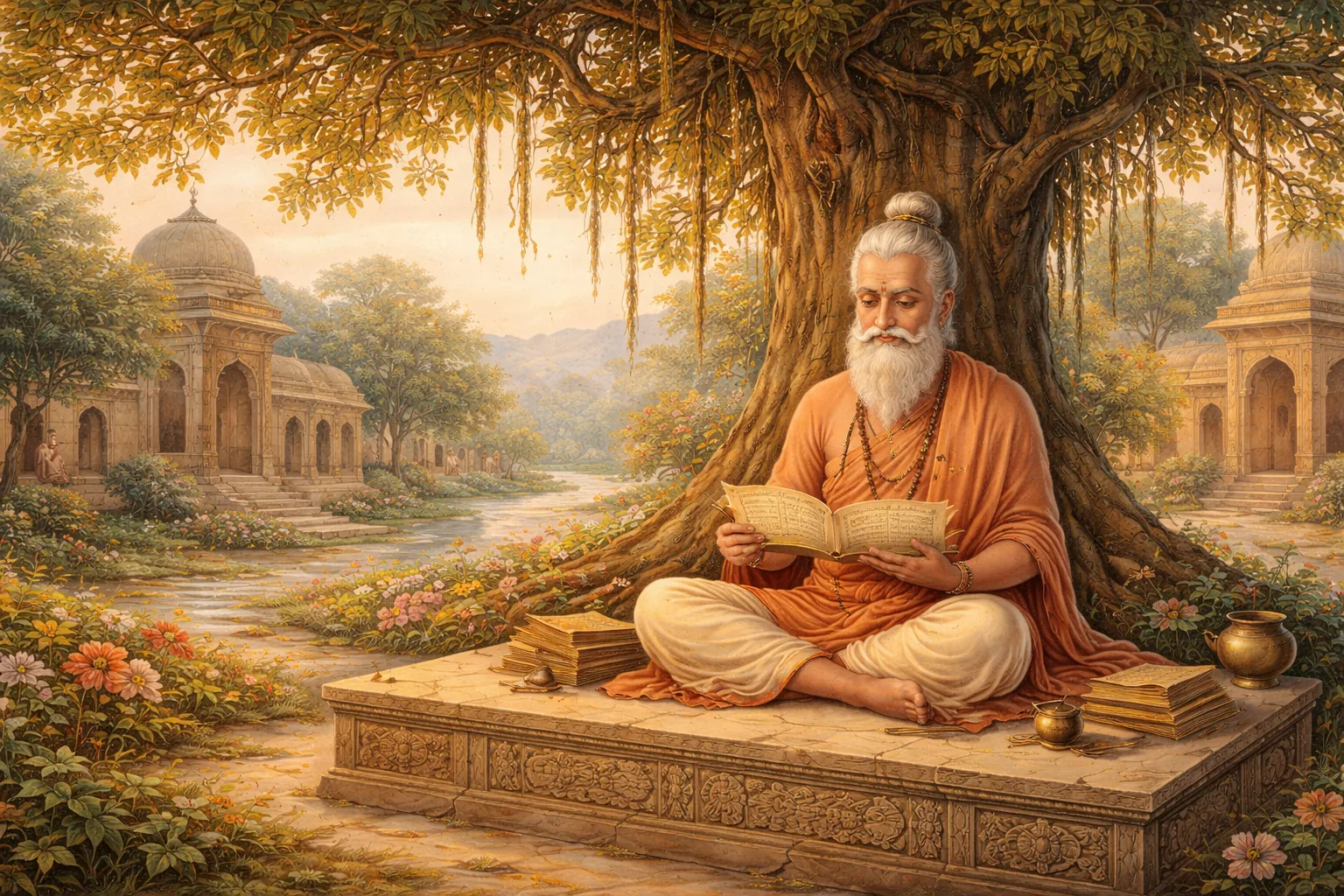
Most people who hear the word "vichara" for the first time imagine a special meditation or an intellectual self-analysis of the nature of consciousness. Others reduce the practice to repeating the question "Who am I?" almost like a mantra. Both understandings lead astray.
Brahma-vichara (Skt. brahma-vicāra) is a direct contemplative inquiry into the nature of the Absolute and one's own "Self," which in the tradition of Advaita Vedanta is considered the closest and most direct path to liberation. As stated in the Vivekachudamani—a treatise by Shankaracharya (788–820 AD): "Of all the means of liberation, Jnana alone is the closest and direct cause; without it, there is no liberation."
What is Brahma-vichara
The word vichara (Skt. vicāra) comes from the root vi-car—"movement in different directions," "thorough investigation." Brahma is the Absolute Reality, the foundation of all that exists. Brahma-vichara is an investigation directed toward this foundation. Not from the outside—from within. Not toward objects—but toward the one who perceives them.
In the teaching of Advaita Vedanta, vichara is threefold.
First—the investigation of the Absolute: reflection on the nature of Brahman beyond qualities, beyond categories, and beyond all concepts. Nirvikalpa, nirguna. This is a contemplative immersion into the nature of the Infinite—what the Guru calls vichara-spanda: "the vibration of consciousness that investigates the nature of God." Awareness directed toward the Absolute and not exhausting itself in this direction is brahma-kara-vritti (Skt. brahma-kāra-vṛtti).
Second—the investigation of Ishvara: God in His manifestation, Brahman with qualities. The investigation of Ishvara is another facet of the same vichara. Here, the mind seeks God in His action, in the universe, and in the Teacher.
Third—the investigation of one's own "Self" (atma-vichara, Skt. ātma-vicāra): understanding that our "Self" is the Absolute itself. This is what the Vedic formula "Tat Tvam Asi"—"Thou Art That"—expresses. In us, Brahman is represented as Atman—and Atman is separate from the five sheaths, from the body, mind, and will. It is not the doer. It is the witness.
All three are inseparable from one another. Brahma-vichara and atma-vichara are not different practices, but two movements of a single contemplation.
What the practice is not
Before moving to the technique, the space must be cleared. The mind is very cunning: it knows how to imitate practice without practicing.
Vichara is not a mantra-question. Many hear the advice of Bhagavan Ramana Maharshi—"ask the question 'Who am I?'"—and begin to repeat it rhythmically, like a mantra. A mantra directs the mind to a sound, to an image. Vichara is a turning of the mind to its own source. It is not just another method—it is another direction.
Vichara is not a search for an internal object. Many look for something "behind the chest"—a certain glow or a quiet voice. But the Atman does not exist as an object that can be found and identified. "The true 'Self' is the very radiant nature of the one who is trying to know it," explains Swami Vishnudevananda Giri in his commentary on Ramana Maharshi's teaching. The seeker and the sought are one.
Vichara is not intellectual analysis. Intellect is useful at the initial stage as a tool of discrimination. But the practice itself goes beyond it. "Self-inquiry as a practice is concentration on the feeling of 'I' and nothing more," says Swami Vishnudevananda Giri. No mental dialogue.
Behind each of these "no's" hides a subtle trap that keeps the mind on the surface for years.
The Mechanism: The First-Person Subject
What is the uniqueness of vichara among all contemplative methods?
When meditating on an image, you work with a third-person object: "this." Repeating a mantra—with a second-person object: "you." Developing bhakti—you direct love toward God as the "Beloved." All these practices—wonderful and necessary—are still directed toward something external to consciousness itself. Vichara is the only method where the mind turns to its own source. To the first-person subject: "Who is the one perceiving all this right now?"
Millions of people love external vichara: investigating nature, history, psychology. Only a few turn this same tool inward. That is why there are so few enlightened ones.
When the mind asks this question with sufficient sharpness, it bumps into something that has no form or location. Into a space that cannot be "found" because it itself is the one who seeks. It is in this "bumping" that authentic practice begins.
When you steadily direct awareness toward the Absolute, toward Ishvara, toward the nature of the "I"—a love for this very investigation begins to grow within you. "It is impossible to direct your mind toward anything for a long time without loving it," says Swami Vishnudevananda Giri. Brahma-vichara and bhakti are not opposites. They meet in the depths.
How the practice is performed
Vichara is the "path of the lion," as the tradition calls it. Direct self-inquiry requires maturity of mind: it must be preceded by karma yoga, bhakti, and raja yoga. Without this foundation, the mind is too agitated to hold onto the subtle feeling of "I" for more than a few seconds.
The essence of the practice is not analytics and not meditation on an image. It is the turning of awareness toward its own source: toward the pure feeling of "I am"—before words, before images, before any content. The mind, accustomed to moving toward objects, here turns to the subject for the first time. This turn constitutes the entire technique.
A full introduction to the practice, step-by-step work with the mind, and specific methods of turning are transmitted within the framework of training in the tradition. Practice under the guidance of a Teacher is not a formal requirement, but it is the living transmission that allows one to avoid the traps that are impossible to describe in text.
Key Points
Do not wait for a verbal answer. An experienced practitioner at some point stops formulating the question altogether—and simply abides where the question points. Words were a tool. The tool has done its job.
Several short but sharp sessions throughout the day provide more than one long but sluggish one. Return to the practice in the pauses between tasks, in those few seconds of silence that are always there.
Every time the mind drifts to objects—it is not a failure. It is an opportunity. "And who noticed this?"—and attention is back at its source.
Fruits of the Practice (Phala)
Yoga Vasishtha, Vivekachudamani, and Ribhu Gita describe the fruits of brahma-vichara. The false ego (ahamkara)—automatic reactions, old identifications with the body, mind, and social roles—gradually loses its density. Not in one session. Slowly, like ice melting.
As it deepens, steady discrimination (viveka) is born: a clear vision of what is real and what is not. What is Atman—and what is merely a sheath you took for yourself. This is not speculative knowledge. It cannot be obtained from books—only from the practice itself.
The result described in the texts is establishment in sahaja-sthiti (Skt. sahaja-sthiti): the natural state, where vichara stops being a "practice" and becomes a constant background. The experience of satchidananda (Skt. saccidānanda—existence-consciousness-bliss) is revealed not as an experience that "comes," but as what you always already are. "Authentic Awakening begins with vichara," says the Yoga Vasishtha.
Practice in the Guru's Teaching
In our tradition, brahma-vichara is part of the fivefold formula of the practice of natural contemplative awareness. It does not replace other sadhanas—pranayama, bhakti, service, mantra work—but crowns them. They all prepare the mind: making it sattvic, calm, and sharp enough to hold attention at the source.
"Whatever we do—rituals, mantras, asanas, concentration—we must come to a state where the mind stops, pauses, and shanti, peace, sets in. Our awareness goes inward, investigating the nature of consciousness. This is vichara. Vichara is the essence of Jnana Yoga," says Swami Vishnudevananda Giri.
The practice is available within the framework of the sadhana adopted in the lineage of Swami Vishnudevananda Giri—in the Laya Yoga tradition, which traces back to Advaita Vedanta and Kashmiri Shaivism and includes vichara as one of the basic contemplative sankalpas.
