

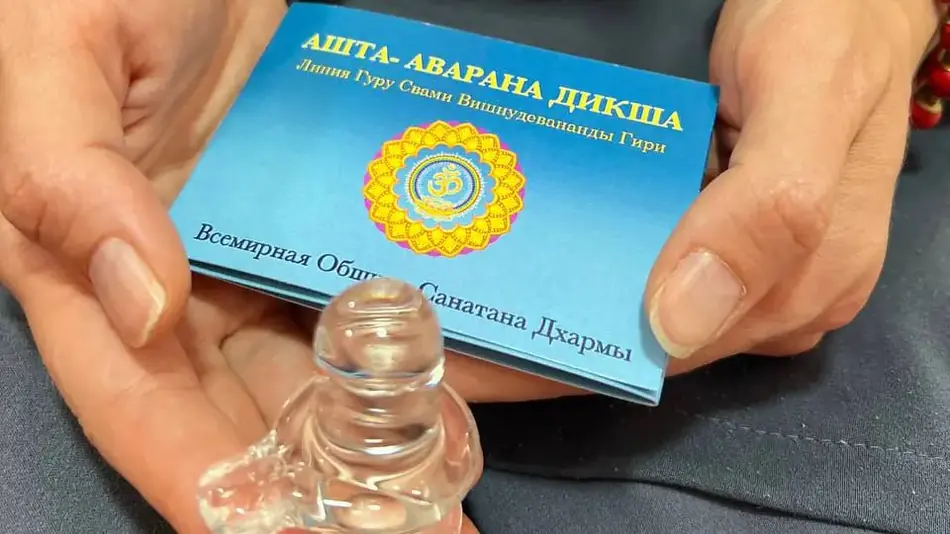
Ashta-avarana-diksha (Sanskrit: aṣṭa-āvaraṇa-dīkṣā) is initiation into the eight protective coverings. The word “ashta” means “eight,” “avarana” means a covering, protection, or sheath. “Diksha” is an initiation that simultaneously bestows spiritual power and removes karmic obstacles.
This is one of the key initiations on the spiritual path in our tradition. It follows the taking of Refuge and creates an invisible yet tangible protective structure around the practitioner—a mandala of eight elements, each of which supports and safeguards them on the path.
Why Protection Is Needed on the Spiritual Path
When a person begins serious spiritual practice—meditation, mantra, pranayama—they gradually open the subtle channels and become more sensitive. This is beneficial because it enables them to perceive deeper layers of reality. But there is also a downside: vulnerability increases.
Old karmic imprints may surface, inner states may intensify, and the influence of external negative energies may grow stronger. Ashta-avarana-diksha creates a protective circle—a raksha-mandala—within which the practitioner can develop peacefully.
“By invoking holy divine powers, we come into harmony, into resonance with these vibrations. And these vibrations themselves change the environment around us. This is spiritual protection.”
— Swami Vishnudevananda Giri, “Vedic Demonology and Methods of Spiritual Protection,” 2010
The Eight Coverings
The eight avaranas are not merely ritual symbols. Each of them has practical significance and changes the initiate’s everyday life.
1. Guru—the Living Connection with the Tradition
The first and foremost covering. The Guru is not merely a “teacher” in the secular sense, but a living link in the chain of knowledge transmission originating from Shiva himself. The Shiva Purana (7.2.37.11) says: “The Guru is Shiva, Shiva is the Guru—they are one.”
In practice, this means that when difficulties arise on the path, one can invoke the Guru’s guidance through remembrance of the Guru (guru-smarana). The Guru becomes the inner compass—the antar-guru.
“Just as one candle is lit from another, so the disciple receives the transmission and becomes a successor in the lineage.”
— Swami Vishnudevananda Giri, “From the Profane to the Sacred,” 2019
2. Linga—the Personal Altar
A lingam consecrated by the Guru and given to the disciple transforms an ordinary dwelling into a small sacred place. The Linga Purana (1.3.1–2) states: “The Lingam is the Supreme Brahman; the Lingam is the supreme tapas.”
Daily linga-puja (worship of the lingam) becomes the center of spiritual life. It maintains a constant connection with the Absolute, even when there is inner dryness and a lack of inspiration.
3. Jangama—the Power of the Spiritual Community
“Jangama” literally means “that which moves”—these are the living bearers of the tradition: monks, experienced practitioners, and sadhus. In Basava’s Lingayat tradition, it is said: “Jangama-lingam is the body of the saint; prana-lingam is the breath of Shiva in all things.”
When personal motivation wanes, the sangha provides support. When doubts arise, the example of other practitioners inspires. And service to the community (seva) transforms personal practice into something greater.
4. Padodaka—Consecrated Water
Literally, “water from the feet.” In the context of diksha, this is charanamrita—the water remaining after the ritual bathing of the lingam. The Padma Purana says: “Shiva’s padodaka destroys all sins.”
This is not magic, but a ritual that reinforces the intention of inner purification. The water absorbs the vibration of the lingam, and by partaking of it, the practitioner internalizes (assimilates) the blessing.
5. Prasada—Consecrated Food
Before eating, you offer food to the deity and then partake of it as prasada—a gift. The Bhagavad Gita (3.13) says: “Those who partake of the remnants of sacrifice are freed from sins.”
A simple act—offering food before a meal—changes one’s attitude toward eating. Food ceases to be mere fuel and becomes part of spiritual practice.
6. Bhasma—Sacred Ash
Ash is applied to the forehead, arms, and chest. The Bhasma Jabala Upanishad says: “A person covered with ash becomes Rudra.” Ash is a reminder of impermanence: everything material burns away, and only the eternal remains.
Wearing bhasma is also a sign of belonging to the Shaiva tradition, a kind of practitioner’s “signature.”
7. Rudraksha—Shiva’s Beads
“Rudraksha” means “the eye of Rudra.” The Srimad Devi Bhagavatam (11.8) says: “Rudrakshas, which arose from the eyes of Rudra, destroy sins.”
Rudraksha prayer beads consecrated by the Guru become a constant companion: they are worn around the neck, used for japa (mantra repetition), and kept by the altar. Rudraksha amplifies the mantra, acting as a resonator. It is prescribed that they be treated with reverence: they should not be worn in impure places and should be removed before sleep.
8. Mahamantra—the Great Mantra of Shiva
The culmination of the diksha. The Guru whispers the mantra directly into the disciple’s ear—this is the karna-mantra. It is not the informational transmission of words, but the transmission of living sonic power. In the Shaiva tradition, this is usually the five-syllable mantra Om Namah Shivaya.
“Mantra diksha grants permission and bestows the power to practice japa yoga. Without this initiation, repeating the mantra is less effective. Anyone can recite the mantra Om Namah Shivaya, but it is better to receive it from the lips of an authorized Guru.”
— Swami Vishnudevananda Giri, “The Significance of Guru Yoga and Diksha for Mantra Practice,” 2018
After initiation, the disciple undertakes to repeat the mantra daily—at least one mala (108 repetitions). Over time, the mantra becomes the background of one’s life: it resonates within even when one is not consciously repeating it.
Spiritual Name
Along with initiation, the Guru gives the disciple a new name. The Guru chooses the name based on his vision of the disciple’s essential nature and connection with the chosen deity.
Within the sangha, you will be known by your spiritual name. In secular life, you may continue to use your former name. Over time, some practitioners switch entirely to their spiritual name—especially when taking monastic vows.
The Place of Ashta-Avarana Diksha on the Path
This diksha is neither the beginning nor the end. It forms part of a clear sequence of initiations:
First stage—taking Refuge (prapatti diksha). This establishes a basic connection with the tradition.
Second stage—ashta-avarana diksha. This creates a protective structure and bestows a spiritual name.
Third stage—ashrama diksha. This determines one’s way of life: grihastha (lay practitioner), brahmacharya, karma sannyasa, or vanaprastha.
Fourth stage—Brahma mantra diksha. The transmission of the supreme liberating mantra.
Each subsequent diksha deepens the connection with the Guru and the parampara, bringing one closer to moksha—Liberation.
“By receiving initiation, we create new imprints on the spiritual path—divine imprints. And they allow us to discover other possibilities within the universe.”
— Swami Vishnudevananda Giri, “The Meaning of Life as Spiritual Evolution in Advaita,” 2010
Preparation and Requirements
Ashta-avarana diksha is available to those who have already taken Refuge. The procedure is as follows:
Take Refuge—with a monk, either online or in person. Without this step, the transmission of the avaranas will not be effective.
Register—with the ceremony coordinator (Tejomayi), stating your intention.
Prepare dakshina—a ritual offering to the Guru. This is not a payment, but an expression of gratitude and a willingness to let go of the material for the sake of the spiritual. The amount depends on your means and usually takes the form of a donation to the monastery.
How the Ceremony Is Conducted
The ceremony lasts one to two hours. It is conducted individually or for a group, either in person at the ashram or online.
Purva puja—preliminary worship.
Guru vandana—glorification of the Guru and the lineage.
Sankalpa—a formal declaration of one’s intention to receive diksha.
Transmission of the avaranas—one by one, with an explanation of each.
Nama dana—the bestowal of a spiritual name.
Mantra upadesha—the transmission of the maha-mantra, whispered into the ear.
Ashisha—the concluding blessing.
During the ceremony, people have different experiences: waves of devotion, unusual clarity, or peace. But most importantly, the effect of diksha is not limited to this moment. The power of initiation works for months and years, gradually transforming consciousness.
After Diksha: What Changes in Life
After initiation, you are a dikshita, an initiate. You acquire formal status within the parampara and daily obligations:
— Linga puja—daily worship of the lingam in the morning or evening.
— Nitya japa—repetition of the maha-mantra at least 108 times a day.
— Wearing rudraksha—as a constant reminder of your connection with the tradition.
— Applying bhasma—before practice or on special days.
— Serving the community—seva in an accessible form.
These practices are not an additional burden on top of ordinary life. They become integrated into it and gradually transform the entire daily routine—from waking up in the morning to falling asleep.
Questions about taking part in the ceremony can be directed to the coordinator, Tejomayi.
Om Namah Shivaya
