

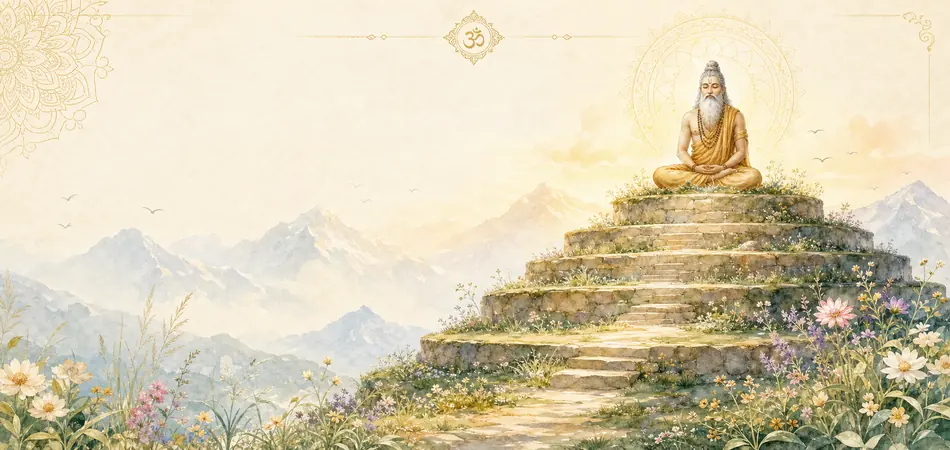
Thousands of years ago, sages described seven stages of inner transformation that every seeker passes through—these stages are called the seven grounds of wisdom (Sanskrit: sapta-jñāna-bhūmikā) and are explained in detail in the Yoga Vasistha.
Guru Swami Vishnudevananda Giri says that all of us, as living beings, occupy a place on this ladder of seven bhumis. The saints are at its summit, while we are somewhere on the first few rungs. Sometimes moving from one bhumi to another requires an entire lifetime—this is what spiritual evolution is all about. A sadhu’s task is to make the leap: to burn away karma, dissolve the mind, awaken awareness, and move to the next level.
First Bhumi: Shubheccha—Noble Aspiration
On the first ground of wisdom, a sincere longing for truth arises within a person. They begin to seek and to ask questions that had never occurred to them before. They are drawn to spiritual texts, to communion with the wise, and to service.
The Guru describes the signs of the first bhumi simply: a person serves saints and sages, performs seva, visits temples, participates in worship, and takes an interest in spiritual matters. They are in the flow—and that in itself is no small thing.
Second Bhumi: Vicharana—Self-Inquiry
The second ground is the stage of active inquiry. The yogi studies the scriptures, practices methods, investigates the mind, and through atma-vichara clarifies awareness and the principles of consciousness. Here, real work with the mind begins, rather than a mere interest in spiritual life.
According to the Guru, enlightenment may occur precisely on the second bhumi. He says that enlightenment comes on the second ground of wisdom, and for those who do not attain it on the second, it will certainly come on the third.
Third Bhumi: Tanumanasa—Attenuation of the Mind
The practitioner’s mind becomes subtle and transparent. The third bhumi is a state of constant immersion in subtle contemplation. Attention becomes one-pointed and steady, and certain abilities may awaken.
One who has passed through the first three grounds of wisdom is called a mumukshu—“one who longs for liberation.” Up to the fourth stage, the path still allows for fluctuations, and karmic vision may change significantly from one bhumi to another.
“The karmic vision of a person on the first bhumi and that of a person on the third bhumi are very different. With each successive bhumi, the experience of Ishvara’s qualities grows deeper, the experience of the nondual Brahman grows deeper, and there is progressively less ego, karmic identification, and dualistic conception.”
— Swami Vishnudevananda Giri
Fourth Bhumi: Sattvapatti—Self-Realization
The fourth ground is the turning point of the entire Path. Here, the practitioner attains samadhi and gains a stable experience of turiya—the fourth state of consciousness, beyond waking, dreaming, and deep sleep. One who becomes established at this stage receives the title of brahmavid—“one who knows Brahman.”
The Guru explains that it is the fourth ground of wisdom that truly bestows vairagya (dispassion), because turiya burns away the vasanas. It brings about vasana-kshaya (the destruction of latent tendencies) and mano-nasha (the dissolution of the mind). From this moment onward, samsara, karma, and the material world no longer hold sway over the practitioner.
Fifth Bhumi: Asamsakti—Non-Attachment
At the fifth stage, consciousness ceases to become involved in external and internal processes. At this stage, the subtlest connections between objects, indriyas (organs of perception), and consciousness are severed. The yogi has realized the Absolute both in the emptiness of the unmanifest and in the form of energy, and has mastered liberation. Now they begin to manifest divine qualities within themselves.
One established on the fifth bhumi is called a brahmavidvara.
Sixth Bhumi: Padarthabhavana—Disappearance of Objecthood
At the sixth stage, the yogi experiences a boundless ocean of light behind all objects. They see the one Brahman more than the external world and never lose the presence of this ocean of light. Divine will begins to act through them—they become, in the Guru’s words, “the hand of the Lord.”
One who has attained this stage is called a brahmavidvaryan.
Seventh Bhumi: Turyaga—The Transcendent State
The summit of the Path. The yogi has completely merged with divine providence. Divine deeds are accomplished through them, and kriya-shakti manifests. They may manifest as an avatar, as the creator of the Universe, or as a deity sustaining the laws of creation. Here there is no longer any division between “God” and “me”—there is only the One.
One established on the seventh bhumi bears the highest title—brahmavidvarishtha.
“When, upon completing the negation ‘not this, not this,’ perfect fullness shines forth for those who abide in samadhi, then I am the Brahman beyond the three states, nondual, one, supreme, and eternal.”
— Adi Shankaracharya, “Viveka Chudamani”
The Difference Between Enlightenment and Liberation
The Guru emphasizes an important distinction: enlightenment and liberation are not the same thing. Enlightenment may occur as early as the second or third bhumi, when the yogi experiences turiya and recognizes their true nature. But liberation—moksha—comes later, through the complete dissolution of all samskaras and vasanas, through prana—the cosmic energy of Bhuvaneshwari.
There are also pitfalls along this path. The Guru warns of three of them: becoming captivated by bliss (when the yogi thinks that the experience of bliss is already liberation), becoming captivated by clarity (fascination with astral vision and multidimensionality), and becoming captivated by emptiness. Each of these pitfalls can halt progress for a long time.
The Path and the Fruit
The seven grounds of wisdom are a map against which one can measure one’s progress. They show that the spiritual path has specific stages and specific fruits. From the first wholesome aspiration to complete unity with the Absolute, each step has its own signs, trials, and attainments. And the path to these heights begins with something small—with the conscious taking of Refuge.
