

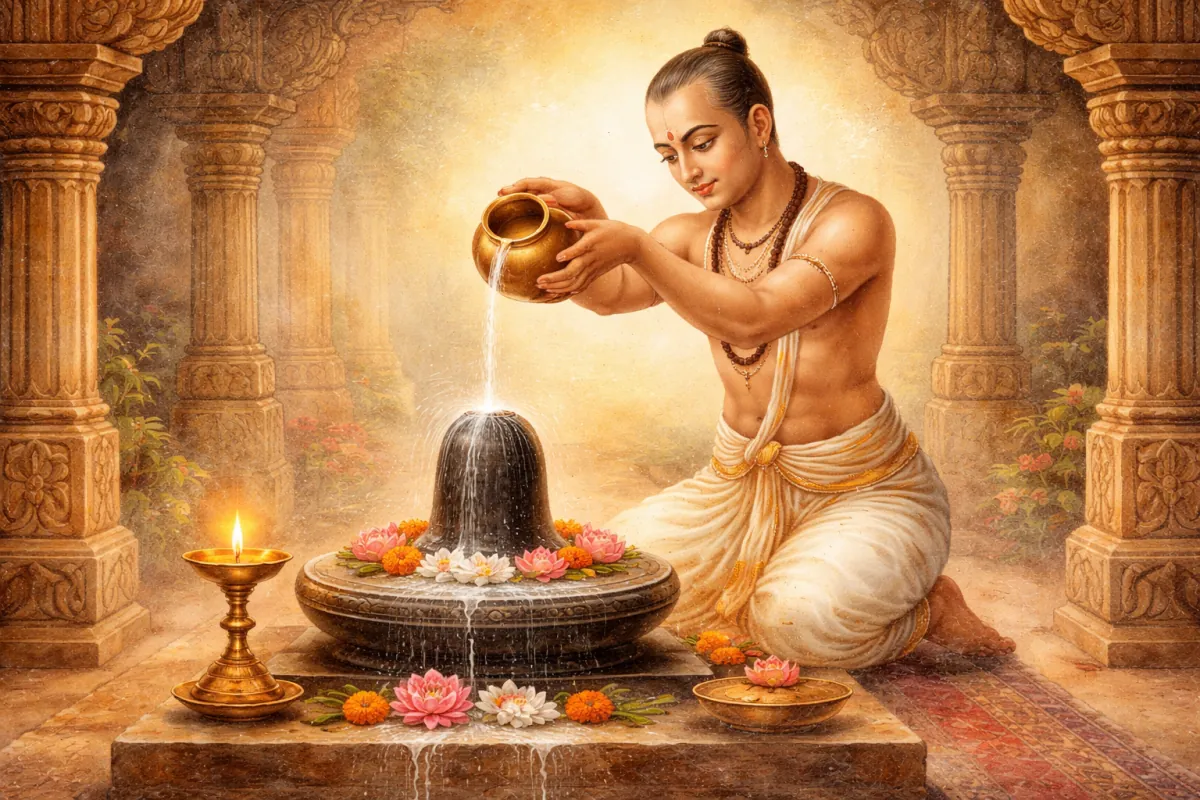
At dawn, millions of people light a lamp before an image of God. In temples, the first of seven daily services begins. Thousands of families offer oblations to the gods and ancestors into the fire of the homa. This flow of ritual is uninterrupted—neither by day nor by night, anywhere in the world where tradition lives. In Sanatana Dharma, ritual is a precise tool for working with reality.
This article describes the main forms of ritual practices, their internal logic, and their place on the spiritual path. Each form is analyzed in detail in separate articles; this piece serves as an introduction to the topic.
What is Ritual in Sanatana Dharma
In most Western traditions, ritual is a symbolic repetition: a remembrance of the past, a reproduction of a sacred event. Sanatana Dharma proceeds from a different logic: ritual produces a real effect in the invisible planes of being.
The Sanskrit kriyā ("action, rite") is related to the verb kṛ—"to do." The same word lies at the root of the concept of karma: every rite is a cause that generates an effect. A ritual action performed with intention, mantra, and knowledge carves a channel between worlds.
The Agamas—the body of ritual and metaphysical scriptures of Shaivism—view worship as a meeting of three planes of existence: the physical (bhur), the subtle (bhuvas), and the causal (svas). When a priest performs abhisheka, or a householder lights a lamp before a murti, the subtle body of the gods approaches that point in space. Ritual is the coordinate of the meeting.
Three Sources of Consecration
"The three sources of life for the twice-born are the temple, the shastras, and the guru-disciple tradition."
In the Shaivite tradition, a temple is not a meeting place. The Agamas describe it as the body of Shiva in architectural embodiment: the courtyard is the legs, the hall is the body, and the vimana over the sanctuary is the head. To enter a temple is to enter the Presence. The Shastras provide the form and meaning of the ritual. The Parampara—the living chain of teachers and disciples—transmits the power accumulated over millennia of flawless execution.
A ritual detached from one of these three sources gradually loses its efficacy. Form without a Shastric foundation turns into folklore. Knowledge without living transmission remains mere theory.
The Four Stages of Religious Life
The Tirumantiram—one of the primary texts of Shaiva Siddhanta—outlines four stages of the spiritual path:
Charya (caryā) — ritual service through the body. A person comes to the temple, cleans, decorates, and observes precepts. Discipline and external action are the primary tools.
Kriya (kriyā) — worship and external rite. Performing puja, samskaras, and participating in festivals. The intention is already directed toward God, not just toward the rule.
Yoga (yoga) — internal practice. Meditation, pranayama, dharana. The external rite moves inward.
Jnana (jñāna) — knowledge and realization. The stage where the boundaries between the practitioner and the Practiced are erased.
This scheme does not describe a ladder where ritual is left behind. On the contrary, it views charya and kriya as the foundation without which jnana loses its stability. Ritual builds the structure within which realization is possible.
Five Mandatory Practices — Pancha Nitya Karma
The Tantric tradition formulates the ritual duty of a householder in five constant practices—pañca-nitya-karma:
- Dharma — righteous conduct, adherence to ethical norms
- Upasana — daily personal practice: prayer, meditation, recitation of mantras
- Utsava — participation in community festivals
- Tirthayatra — pilgrimage to sacred places
- Samskara — performance of life-cycle rites
These five practices are interconnected. Upasana provides the internal foundation, Dharma the ethical context, Samskaras structure the life path, Utsava connects one to the community, and Tirthayatra leads beyond ordinary space. Together, they encompass all dimensions of life—personal, family, and social.
Puja: Daily Worship
Puja (pūjā) is the central form of ritual worship. The word has several etymological versions; the most common links it to the Dravidian root pu ("flower")—the image of an offering to God.
Home Puja (griha-puja) is performed daily before the family altar. A murti or image is placed in a designated spot, a fire is lit, flowers and incense are offered, and mantras are recited. A minimal rite takes a few minutes; the traditional form can take up to an hour.
Temple Puja is performed by a qualified priest according to Agamic prescriptions. In large Shaivite temples, worship takes place six or seven times a day, following the solar cycle. Each service includes abhisheka (ritual bathing of the murti), dressing, and the offering of flowers, food, light, and incense. It concludes with arati—the circular movement of a burning lamp.
The Agamas regard puja as archa-avatara—the descent of God into a consecrated image. A murti in a consecrated temple is not a symbol or a reminder. It is a place of real Presence.
Read more about Puja.
Yajna and Homa: The Sacrificial Fire
Yajna (yajña)—Vedic sacrifice—is one of the most archaic forms of ritual. In a domestic context, it is preserved in the form of homa: a sacrificial fire into which ghee, grains, herbs, and mantras are offered.
The Vedic tradition identifies pancha-maha-yajna—five sacrifices that a householder performs daily:
- Brahmayajna — study of the scriptures (offering to the gods of knowledge)
- Devayajna — fire sacrifice
- Pitriyajna — offering to the ancestors
- Bhutayajna — offering to all beings
- Manushyayajna — hospitality (offering to humans)
Fire is one of the five forms of Shiva: Agni-lingam, the flame that transforms what is offered. This is why no important transition—neither birth, nor marriage, nor death—is performed without a homa.
"Agni is the mouth of the gods."
Rigveda
Through the fire, the offering reaches the subtle plane. Homa connects the material world with the world of the gods in a literal sense: the smoke rises, and the transformed form passes through the fire.
Samskaras: Rites of Passage
Samskaras (saṃskāra) in the sense of rites of passage is a system of sixteen rituals (shodasha-samskara) that accompany a person from conception to burial. Each key milestone—birth, naming, the start of education, marriage, death—receives sacred consecration through mantra, fire, and the presence of the community.
The Manu Dharma Shastra formulates the purpose of samskaras directly:
"With the sacred rites prescribed by the Vedas, the ceremony of conception and other rites for twice-born men should be performed—for the consecration of the body and for purification in this life and after death."
Manu Dharma Shastra
Samskara is part of Pancha Nitya Karma; its performance is not optional for those living within the tradition. A detailed description of all sixteen rites is in the article Samskaras, Sacred Rites of Passage.
Upasana: Personal Discipline
Upasana (upāsanā, "sitting near, service") is daily personal practice: prayer, meditation, recitation of mantras, and study of the shastras. Here, there is neither priest nor community—it is one-on-one with God.
The foundation of upasana is sandhyavandana—the triple prayer at dawn, noon, and sunset. Performing it is the direct duty of one who has undergone upanayana. With the acceptance of the sacred thread, a boy takes this practice upon himself for life.
Where puja is performed through the body and materials, upasana is performed through the mind and intention. The Tirumantiram describes upasana as the soil without which external ritual remains empty movement.
Utsava: Festival as Community Ritual
Utsava (utsava, "that which elevates") is the collective dimension of ritual life. Festivals take practice beyond the home altar and make it an event of the community and tradition.
Texts describe a festival as a special state in which the usual boundaries between worlds thin out. On the days of Maha Shivaratri, Navaratri, or Ganesha Chaturthi, the subtle plane is open in a way different from ordinary time. Participation in utsava is not an addition to practice, but one of the five components of Pancha Nitya Karma.
A complete map of the year's festivals is in the article Utsava — Sacred Festivals in the Tradition of Sanatana Dharma
