

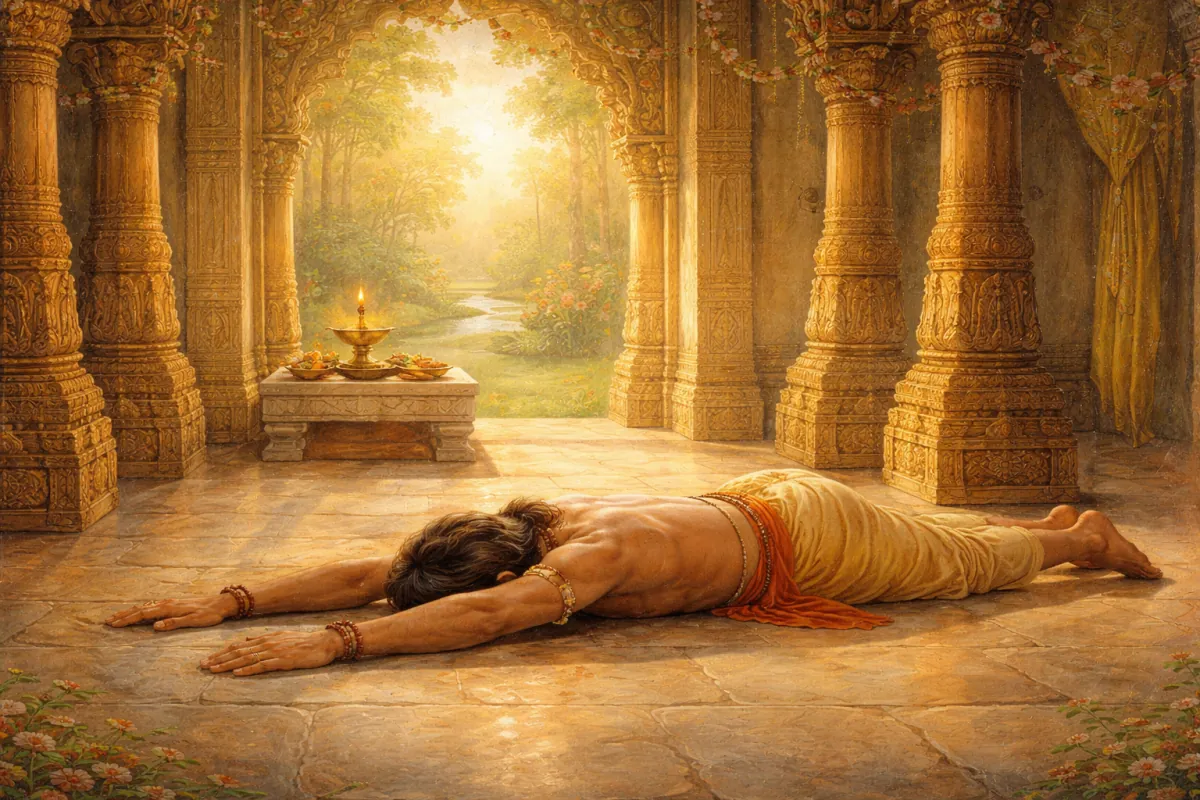
The forehead touches the floor. The arms are stretched forward. The body is extended on the ground — this is exactly how the traditional formula describes a full prostration. In this position, what is commonly called pranama (Skt. praṇāma, from pra — "forward" and namas — "bowing") occurs: the practitioner establishes direct contact with the consciousness of the one before whom they bow.
Pranama is part of the system of preliminary practices (purva-seva), which prepare the consciousness for the subtler stages of yoga and contemplation. In the tradition of Sanatana Dharma, it is understood as one of the methods of upasana — the practice of worship, which leads from external forms of addressing the Supreme to gradual internal union with it. Regular prostrations establish a living connection with the Guru, with the ishta-devata (chosen deity), and with the entire line of spiritual succession (parampara).
Types of Bows
The tradition distinguishes several forms of pranama, each corresponding to a certain degree of expressing self-surrender.
Dandavat-pranam (daṇḍavat praṇāma, literally "falling like a stick") — a full prostration on the ground: the body is extended, arms are stretched forward, the forehead touches the floor. The most complete external form of surrendering oneself to the Supreme.
Ashtanga-pranam (aṣṭāṅga praṇāma, "bow with eight parts of the body") — the forehead, chest, both palms, both knees, and both sets of toes touch the ground simultaneously. Traditionally performed before the Guru, murtis in temples, and sacred objects.
Shashtanga-pranam (ṣaḍaṅga praṇāma, "bow with six parts") and panchanga-pranam (pañcāṅga praṇāma, "bow with five parts") — variations common in different lineages of the tradition for men and women, respectively.
Pada-namaskar (pāda-namaskāra) — a bow with the touching of the feet. The practitioner bows and touches the feet of the Guru or elders, then brings their hands to the forehead or heart. In the tradition, the feet are considered the focal point of anugraha — blessing energy, and touching them opens the way to receiving this grace.
Anjali-mudra (añjali-mudrā) — joining the palms before the chest or face. Anjali is the initial form of expressing respect, which often accompanies other types of pranams.
Spiritual Meaning of the Practice
Synchronization of Consciousness
The practice of bowing in the tradition is a process of spiritual synchronization. When a practitioner performs a pranam before the Guru, ishta-devata, or saints, their consciousness comes into contact with the consciousness of the one to whom the bow is directed.
Swami Vishnudevananda Giri explains this principle as follows:
"When we do pranam, dandavat, padanamaskar, namaskar, the meaning of this is synchronization with the consciousness of the one to whom we show respect: the Guru, sadhus, a deity, or saints. If you have a Guru or an ishta-devata — everything the Guru has flows to the disciple, everything the ishta-devata has gradually, not all at once, flows to the upasaka — the worshiper."
Just as two devices synchronize data upon connection, the practitioner, through sincere address, opens themselves to the transmission of spiritual power (shakti-pata) and grace (anugraha).
Taming the Ahankara and Purifying the Mind
The physical position of the body affects the state of the mind: by adopting a posture of humility, the practitioner creates conditions for the weakening of ahankara (ahaṅkāra) — false self-identification, the sense of being a separate "I." In the bhakti-yoga tradition, this internal mood is described as dasya-bhava — the position of a servant before the face of the Lord. Through a concrete bodily action, the practitioner returns to this state again and again.
On a subtler level, prostrations work with three types of mind impurities: mala (impurity) — contamination by impure impressions and samskaras; vikshepa — distraction and instability of attention; and avarana — the veil of ignorance that hides the true nature. Until these impurities are removed, subtler practices of contemplation remain difficult to achieve.
Renewal of Intention
There is another layer of meaning — constant reminding. In the flow of time and circumstances, the practitioner is prone to forgetfulness. A bow before the altar or the Guru renews the sankalpa — the intention to move along the path.
"This is our way of constantly reminding ourselves, because we are always prone to forgetting under the pressure of karma," says Swami Vishnudevananda Giri.
How to Perform
As a rule, bows are performed before the Guru, murtis, the altar, sacred texts, as well as in the direction of saints and siddhas. The practice is part of the daily nitya-karma: during the morning, afternoon, and evening sandhya, prostrations are performed along with the pancharatna-pranama-mantra.
Accepted norms: three prostrations — before any practice; 108 — the standard daily norm; 1008 — for intensive purification; 100,000 — as part of preliminary practices in tantric traditions.
Prostrations are accompanied by the recitation of mantras — aloud or mentally. The most common are: Oṃ namo bhagavate ("Salutations to the Blessed One"), Oṃ namo nārāyaṇāya ("Salutations to Narayana"), Oṃ namaḥ śivāya ("Salutations to Shiva"), or the mantra of the lineage of succession.
Read the detailed instructions: how to perform prostrations.
Internal Attitude
The external form of the bow is only a shell. The practice is filled with meaning along with the correct internal state: shraddha (śraddhā) — faith and trust; bhakti — devotion and love; vinaya — humility and respectfulness; viveka — discrimination between the true and the false. Without an internal mood, a prostration provides only physical exercise. With the correct state of mind, the same posture becomes a tool for spiritual transformation.
Fruits of the Practice (Phala)
Regular sadhana of prostrations acts on several levels. On the physical level — it strengthens the body, purifies the nadis (energy channels), and develops endurance. On the energetic level — it activates the flow of prana, removes blocks, and enhances receptivity to anugraha. On the spiritual level — it weakens ahankara, accumulates punya (merit), cleanses the mind of kleshas, and strengthens the connection with the Guru and the lineage of succession.
Every sincere prostration leaves a samskara — a karmic imprint that over time transforms the practitioner's character: pride gives way to humility, alienation to living devotion.
From Outer to Inner
As the practice deepens, external bows become the foundation for internal work. Through physical forms — dandavat, ashtanga-pranam, pada-namaskar — the practitioner comes to understand that true pranama occurs at the level of the mind.
At the highest stages, the entire mind "prostrates" before the Absolute at every moment in time. This state is described in the tradition as manasa-puja — mental worship. It corresponds to sharanagati (śaraṇāgati) — complete surrender to the Supreme Reality, where the distinction between the worshiper and the object of worship dissolves into unity.
Prostrations in the Laya-yoga system begin with a specific bodily action. Where they lead is toward making one's entire life a continuous effort to remain in connection with the Divine.
Pranama (Skt. praṇāma, from pra — "forward" and namas — "bowing, reverence") is a practice of prostrations that holds a special place in the system of spiritual work of Sanatana Dharma. It is part of the complex of preliminary practices (purva-seva), which prepare the practitioner's consciousness for the subtler stages of yoga and contemplation.
