

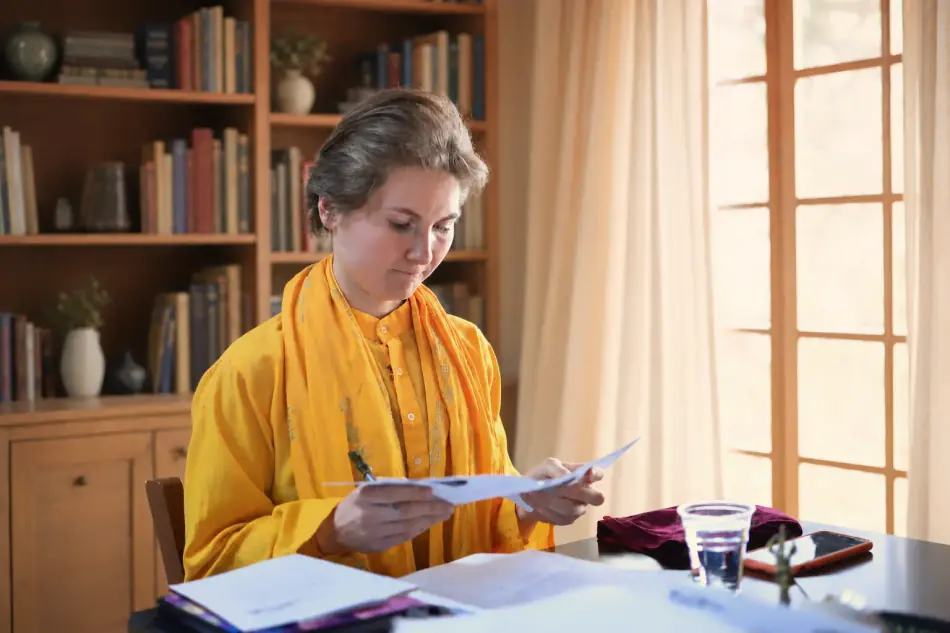
Advaita Vedanta is direct knowledge of the nature of non-dual reality, which lives through practice and is transmitted from Guru to disciple.
Three Pillars of the Tradition
I. Advaita Vedanta
Advaita comes from the Sanskrit for “not two.” The teaching asserts that Atman—the individual “self”—is identical to Brahman, the Absolute. All the diversity of the world is maya, an appearance. The goal of the practice is the direct experience of this non-duality.
Learn more about Advaita Vedanta →
“Tat tvam asi”—“You are Brahman.”
II. Anuttara Tantra
The Path Beyond the Mind
The dissolution of all dualistic notions and concepts.
Laya means “dissolution.” This path combines methods of meditation and contemplation transmitted through the lineage of the siddhas. It is intended for those who seek not only to study but, above all, to practice.
Materials on Laya Yoga in the Siddha tradition →
III. Lineage
A Living Chain of Transmission of the Teaching
Parampara is an unbroken chain of transmission from teacher to disciple. Swami Vishnudevananda Giri received transmission in the lineage of Adi Shankaracharya and the 18 Tamil siddhas.
The Best Place to Start
A series of video lectures for those entering the teaching →
Introductory Articles:
- What Is Sanatana Dharma?
- Why Is a Guru Needed on the Spiritual Path?
- What Is Meditation in Advaita Vedanta?
- Samadhi—the State Everyone Seeks
Map of the Path
What the Path Looks Like from Beginning to End
A unique map of the 16 stages of enlightenment in the tradition—from the first awakening to complete dissolution in the Absolute. Interactive and illustrated.
Answers to the Main Questions
Why Is a Guru Needed?
A Guru is not a teacher in the conventional sense. It is someone who has already experienced Liberation and is capable of transmitting this state directly.
Without a Guru, the mind goes around in circles within its own concepts. The Guru breaks this cycle.
What Is Diksha?
Diksha is initiation, a spiritual consecration. It creates a subtle connection between Guru and disciple and opens access to the transmission of methods of practice.
After diksha, the disciple receives a spiritual name and takes on commitments.
How Does Sanatana Dharma Differ from Yoga?
Yoga is one of the paths of Sanatana Dharma. Sanatana Dharma is the entire system: philosophy, ethics, ritual, practice, and way of life.
In this context, yoga is not fitness, but one of the eight methods for attaining samadhi.
What Is Samadhi?
Samadhi is the state of complete dissolution of the individual “self” in the Absolute. It is neither a trance nor a loss of consciousness, but the ultimate expansion of awareness, in which there is neither observer nor observed.
This is the goal of the entire practice.
Ready to Move from Knowledge to Living Practice?
