

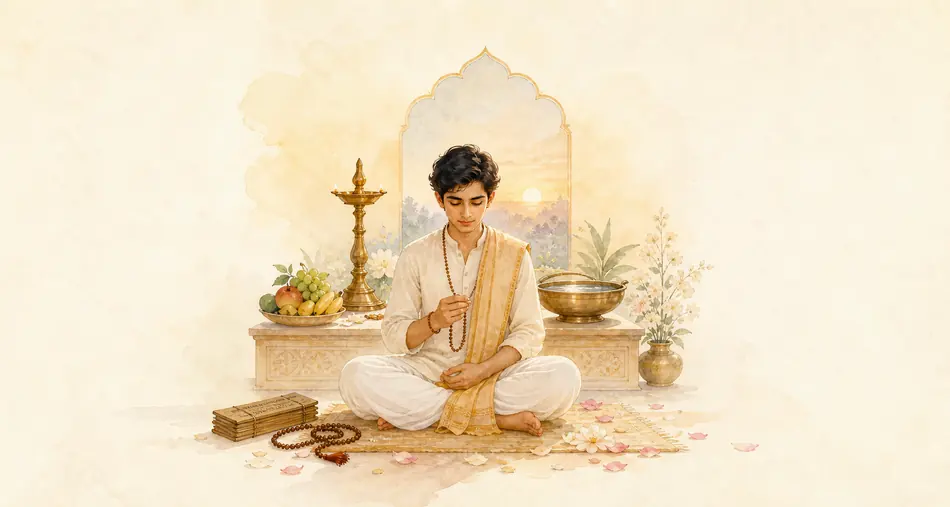
After taking Refuge, a special period begins. It is a time of quiet, painstaking work. This stage is called the preliminary practices, and it lasts approximately one year. During this year, the entire foundation on which the further Path will rest is laid: a correct understanding of the Teaching, trust in the lineage, discipline of the mind, and purity in everyday life.
Why exactly one year? Because consciousness changes slowly. You can read a dozen books in a month and remain the same. Or you can thoughtfully live through every text, every mantra, every morning worship—and after a year discover that you see the world through different eyes.
Why Preparation Is Necessary
In his lectures, the Guru often expresses the idea that a sadhu takes an active stance: resolutely and purposefully striving to eliminate ignorance within a single lifetime and making the most vigorous efforts to do so. This is precisely why our tradition has preliminary practices that require extensive reflection—on impermanence, on the uniqueness of human birth, on the law of karma, and on the suffering of samsara.
These reflections are the foundation. Without them, subsequent methods of contemplation will remain superficial. The mind must first become genuinely convinced that change is necessary.
“It is impossible to become enlightened while obscurations and unwholesome karma remain. They must be stopped and purified, and therefore we perform preliminary purification practices and repent of all the unwholesome actions we have committed.”
— Swami Vishnudevananda Giri, commentary on purification practices
Mastering Philosophy
During the first year, the disciple gradually masters the basic texts of the Tradition. The three principal texts are the “Tripura Rahasya,” the “Yoga Vasishtha,” and Sri Adi Shankaracharya’s “Viveka Chudamani.” Among the Guru’s books, “The Radiance of Precious Mysteries” (Volumes 1 and 2), “The Universe of the Jnani,” “The Source of Consciousness,” “My Life in God,” and “The Vessel of Dharma” (Volumes 1 and 2) are recommended.
It is important to understand that reading these texts differs from ordinary reading. The Guru emphasizes that the process of spiritual learning is fundamentally different from academic study—personal contact, attunement to the lineage, and inner honesty are essential here.
Daily Worship
From the first days after taking Refuge, the disciple incorporates daily ritual forms into their life: the practice of the “Sutra” and “Bhajan Mandala,” worship at the home altar, and the performance of arati. This establishes the rhythm of spiritual life—the sense that every day has a sacred dimension.
One of the first Refuge practices is the daily offering to the Three Jewels. The Guru teaches that after taking Refuge, one should make an offering by bringing prepared food, drinks, and fruit to the altar. If there is nothing material to offer, one can do so mentally or place at least a bowl of water there. When making the offering, one should imagine the Refuge Tree and visualize the gifts transforming into nectar.
Mantra Sadhana
The daily recitation of mantras—from one to seven rounds—becomes the backbone of spiritual discipline. The main mantras at this stage are OM NAMAH SHIVAYA (an invocation to Shiva) and OM DRAM DATTATREYAYA NAMAHA (an invocation to Dattatreya). Regular japa purifies consciousness and deepens the connection with the Ishta-devata.
Sandhya Upasana and Prasad
The disciple masters the practice of sandhya upasana—the veneration of the transitional moments of the day: dawn, noon, and sunset. This is a special time favorable for practice. Therefore, disciples regularly perform nitya sadhana at these times, reciting mantras or performing Brahma Mantra Upasana.
During this period, the disciple also learns to receive consecrated food—prasad. Treating food as a blessing changes not only eating habits but also the very perception of the material world.
Throughout this entire stage, the disciple pays attention to observing the principles of yama and niyama, purifying their way of life, and preparing for grihastha diksha. Ethics serves here as a protection for consciousness—it safeguards the subtle changes that have already begun to occur within.
“When we are in a state of complete devotion to the Absolute, openness, receptivity, and vigilance, at that moment all our samskaras and vasanas are blocked. It is like when a king enters the palace and everyone falls still to greet him.”
— Swami Vishnudevananda Giri
Final Assignment
Upon completing the preliminary practices, the student reads the “Yoga Vasishtha” and the “Tripura Rahasya” in full and then writes a treatise entitled “The Qualities of a Student in the Tradition,” drawing on the texts “Viveka Chudamani,” “The Phenomenon of Guru Yoga,” and “The Radiance of Precious Secrets” (Volume 1). This assignment demonstrates how deeply the student has assimilated the spirit of the Teaching and whether they are ready to move forward.
After the Preliminary Stage
Only after completing this year is the student ready for the basic methods of contemplation, profound ritual forms, and intensive sadhana. Those who pass through this stage patiently and honestly lay a solid foundation for everything that will be given later.
Recommended order for studying the sacred scriptures
Recommended reading order for beginners
Recommended order for studying the Teaching. Advanced level
Approved on August 9, 2019, by the founder of the World Community of Sanatana Dharma, Mahamandaleshwar Guru Swami Vishnudevananda Giri.
