


Viveka (Sanskrit: viveka) is discernment between the real and the unreal, the eternal and the transient, Ātman and non-Ātman. In Sanatana Dharma, viveka is discriminative wisdom, without which sādhana remains mixed and the mind continues to take māyā for reality.
The word comes from the Sanskrit root vic — "to divide," "to separate," "to distinguish" — with the prefix vi, indicating separation and precise recognition. Therefore, viveka means not mere rationality, but the inner clarity of buddhi, which separates nitya — the eternal — from anitya — the temporary. Such viveka is placed by the śāstras at the beginning of the path of jñāna, vicāra, and moksha.
The Eternal and the Transient
Hindus know that viveka begins with the most essential recognition: Brahman is real, while transient forms do not possess independent being. This discernment does not lead to contempt for the world, but frees one from delusion. Just as a person in daylight no longer mistakes a rope for a snake, so too a sādhaka established in viveka ceases to take the body, thoughts, desires, and fluctuations of the mind for the true Self.
In the tradition of Advaita Vedānta, this is called nitya-anitya-viveka — discernment between the eternal and the non-eternal. Through it, buddhi ceases to confuse Ātman with the pañca-kośas, and pure awareness with the movements of manas. Then a person begins to see that avidyā keeps the jīva in saṃsāra precisely through confusion: the temporary seems eternal, the means seems the goal, and ego appears to be the true master of life. Viveka destroys this confusion.
The First Quality of the Sādhaka
Śrī Śaṅkarācārya places viveka as the first quality in sādhana-catuṣṭaya — the four treasures of the disciple. After it come vairāgya, ṣaṭ-sampat, and mumukṣutva. This order is immutable. When viveka is present, proper vairāgya is born, because the mind already recognizes the limitations of sense objects. When viveka is absent, even religious life may remain external: a person repeats mantras, reads śāstras, yet still serves ahaṃkāra.
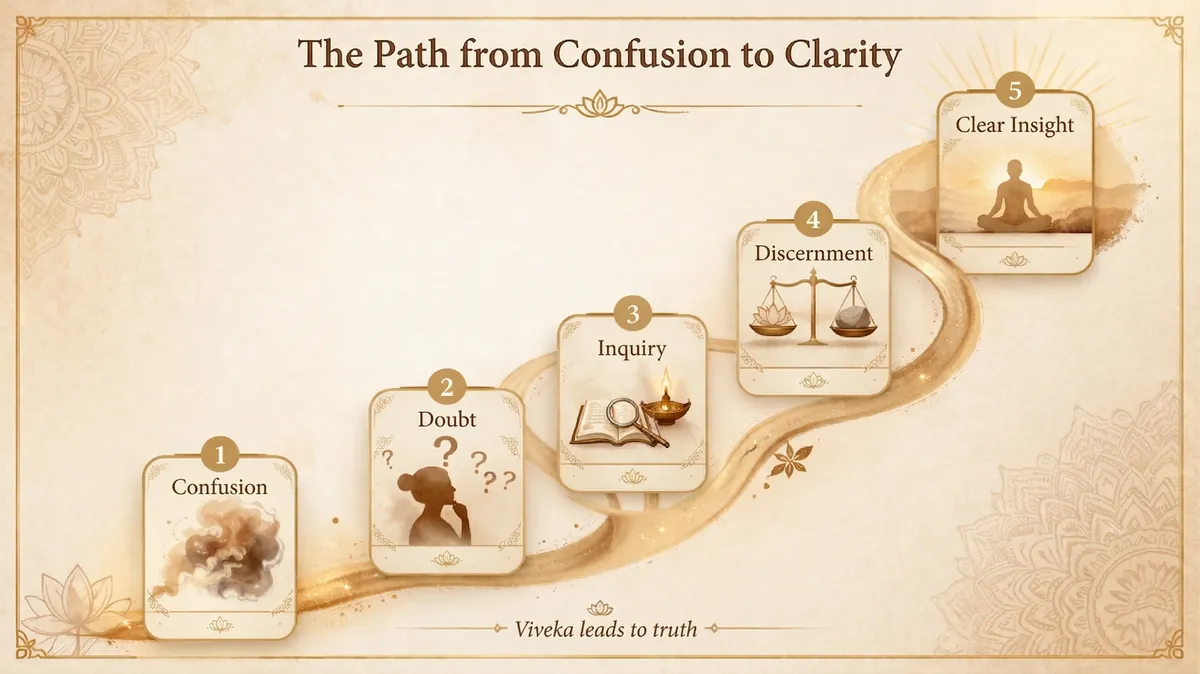
Viveka is also connected with vicāra. Vicāra investigates: "Who am I?"; viveka separates the true answer from false identifications; vairāgya deprives attachments of their power; mumukṣutva directs the whole being toward liberation. Such is the inner alliance of these concepts. They do not exist separately. Where genuine viveka is present, the mind becomes purer, prāṇa more even, decisions more sober, and the path to moksha more direct.
Viveka in Practice
We see the action of viveka not only in abstract philosophy, but also in daily sādhana. It helps distinguish humility from weakness, tapas from violence toward oneself, devotion from dependency, and peace from tamas. Guru teaches that viveka is like a subtle instrument of discernment: with it, the sādhaka recognizes whether love is deepening, whether vision is becoming clearer, whether anger, resentment, and clinging are weakening. Thus discriminative wisdom becomes a measure of spiritual maturity.
Viveka is not born from erudition alone. It is strengthened through śravaṇa, manana, nididhyāsana, the blessing of the guru, and the accumulation of dharma-sukṛti. But once awakened, it begins to lead the jīva inward — from multiplicity to unity, from māyā to Brahman, from fluctuation to samādhi. Therefore, Viveka-cūḍāmaṇi is rightly considered one of the classical texts on the path of discernment: it reminds us that liberation begins where buddhi ceases to confuse the eternal with the transient.
"With the help of discernment (viveka), separate your spirit from the five sheaths. Do not cling to them; this is not you. You are not the body, you are not prāṇa, you are not the subtle body, you are not the mental body, and you are not even the causal body — you are beyond all this. You are the transcendent Spirit."
— Śrī Śaṅkarācārya, "Viveka-cūḍāmaṇi"
