Namaste!

item image

King Janaka’s Awakening: From Worldly Concerns to Self-Realization

author Гуру •date 03.09.2026 •duration 20 min. reading •views 26 просм.

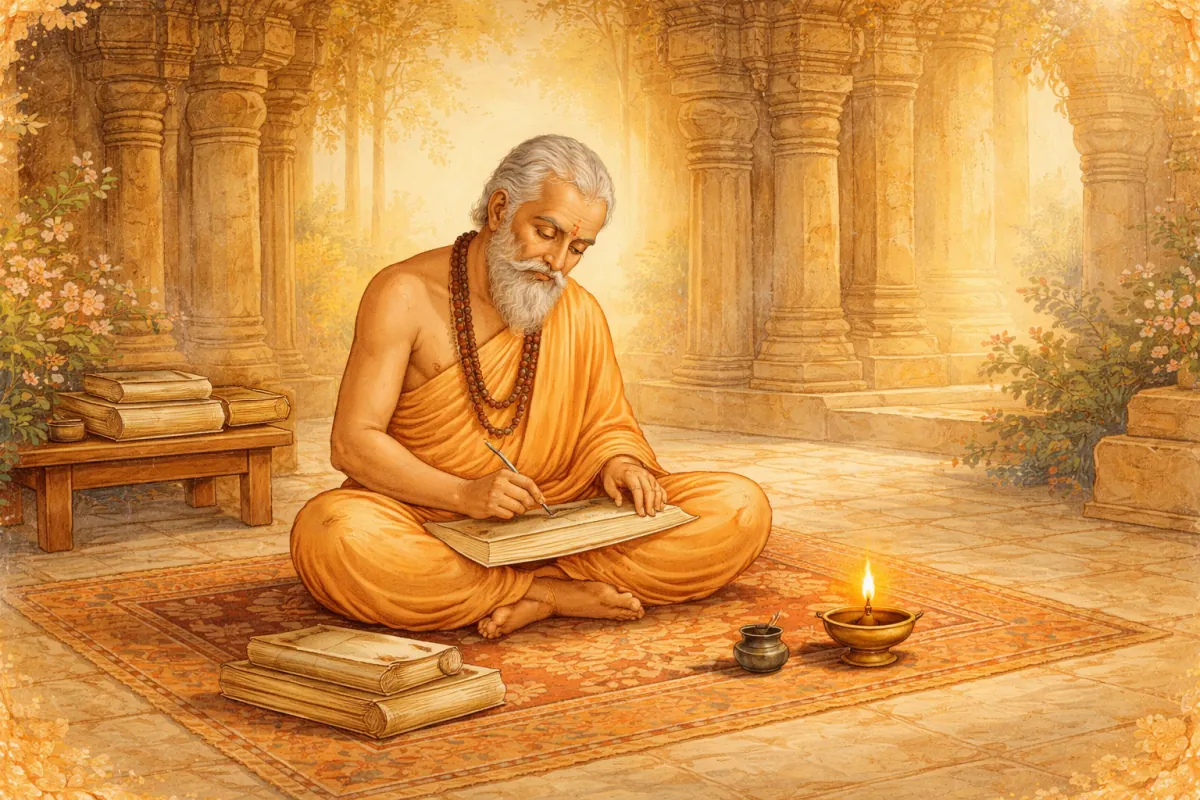
Commentary on the “Yoga Vasistha,” Chapter Five The story of King Janaka. Vasistha continues instructing Prince Rama. He tells him that there once lived a great monarch whose wisdom knew no bounds. His name was Janaka, and he ruled the kingdom of Videha. To those who sought his protection or help, he was a source like the sun. To some he was a horn of plenty, to others a light, and to still others a friend. One day, Janaka entered a beautiful garden and saw certain holy celestial beings there. These celestial beings were singing a song of contemplation. They sang of consciousness, which manifests itself as pure bliss in th
Yoga VasisthaIllusionSelf-inquiryJanakaPresenceVasishthaMananaLiberationConsciousnessAction in inaction
item image

Divine Technologies and the 36 Tattvas of Consciousness

author Гуру •date 03.09.2026 •duration 32 min. reading •views 38 просм.

When we perform pranam, dandavat, padanamaskar, or namaskar, the purpose is to synchronize with the consciousness of the one to whom we are showing respect: a guru, sadhu, deity, or saint. It is the synchronization of consciousness, attunement. If you have a phone and a laptop, a message pops up: synchronize data? If you agree, you confirm, synchronization takes place, and the laptop and the phone contain the same data. The same applies if you have a guru or an ishta-devata: a prompt appears—synchronize data? Yes, and then everything the Guru possesses flows to the disciple; everything the ishta-devata possesses gradually,

ShaivismPure visionMayaAhamkaraTattvaPurusha and PrakritiIshvaraYoga VasisthaKanchukas
item image

Three Dragons on the Path to God: Mala, Vikshepa, and Avarana

author Гуру •date 03.09.2026 •duration 31 min. reading •views 30 просм.

Commentary on the text “Yoga Vasistha,” Chapter 3: “On Creation” No one wants to suffer; everyone wants to be happy. But happiness is not found within us as the soul, as the ego, or as the mind—happiness is found in God. To attain indestructible happiness, one must make one’s way to it, but three dragons stand in the way—mala, vikshepa, and avarana—and they must be destroyed. There are many different forces, energies, and obstacles—the journey in search of happiness is not an easy one; it is a difficult journey, and it requires a great deal of effort. Monastic culture and monastic practice are constant labor on this journe

AdvaitaBrahmanAvidyaBhakti-yogaJnana-yogaMalaYoga VasisthaAvaranaVikshepaRaja-yoga
item image

Thought as a Real Force and the Key to Spiritual Transformation

author Гуру •date 03.09.2026 •duration 24 min. reading •views 30 просм.

Commentary on the text “Swami Sivananda. The Power of Thought” Thought is a real action. It manifests as a dynamic force. A joyful thought evokes a kindred joyful thought in other people. The arising of a noble thought is a powerful antidote and counterforce to an evil thought. Thoughts can be transmitted. Thoughts are a force. On the physical level, we do not understand this until we enter the subtle body. On the subtle level, we begin to understand the nature of thought. For example, if you practice Dream Yoga well, you can see how, as soon as you imagine something, it materializes. If you practice visualization of the i

FaithPower of thoughtMahamayaSwami SivanandaVisualizationBrahmaSiddhiSelf-liberationKarma
item image

Dharma as Refuge and the Seven Principles of View

author Гуру •date 03.09.2026 •duration 43 min. reading •views 38 просм.

Dharma is a reliable Refuge, and there is none more reliable. It is something unchanging, eternal, and unwavering, though very subtle. When we take Refuge in Dharma as immutability, eternity, and steadfastness, all events of the material world are perceived much more simply, easily, and purely, and the material world gradually loses its power over us. It has always sought to wield power over us; unconscious nature is unconscious, while conscious energies are aware, but we deprive material samsara of its power over our consciousness when we practice Dharma, take Refuge, and establish ourselves in the View and contemplation.

Laya-yogaAdvaitaContemplationDharmaKleshasSelf-liberationViewFive ElementsGuru's Answers
item image

Three principles: shravana, manana, nididhyasana

author Гуру •date 03.09.2026 •duration 17 min. reading •views 55 просм.

The teaching requires a particularly reverent attitude. It can be listened to with an open, calm mind; this state is called an “empty vessel.” Why is Dharma so important to us? Why is the teaching so important to us? Why should it be treated with reverence and received in a state of an empty, tranquil mind? Because our future and our life depend on how deeply we understand Dharma and the teachings of the saints. And not only this life, but millions of years to come in future lives. For we seek happiness. We strive not to suffer, to understand our place in the universe, so that our life may be beautiful. We practice Dharma

Shravana, manana, nididhyasanaDharmaSamsaraIccha-shaktiJnana-shaktiKriya-shaktiIllusionAnava-malaKarma-malaMaya-malaTeachingMalas/LimitationsPath of LiberationSahaja-samadhi
item image

Mutual Absorption: The Path to the All-Encompassing “I” in Shaivism

author Гуру •date 02.09.2026 •duration 25 min. reading •views 29 просм.

We will examine such concepts as saha-bhojana (joint absorption), purna-ahanta (the all-encompassing conception of the “I”), the three types of linga: kriya-linga, bhava-linga, and jnana-linga, as well as sva-linga and svayam-linga. These are important concepts in the philosophy of Shaivism for clarifying the ground. The ground is translated as adhara; the ground of everything is God. When we clarify the ground and the ground (God)—that upon which everything rests—has been clarified, our contemplation and our view are unerring. People often have a mistaken view of the universe, God, and creation because the ground has not

Adhara-agniNondualityContemplationLiberationVivekaShivaViewShri Siddhanta ShikhamaniSaha-bhojanaPurna-ahanta
item image

Atma-vichara: A Practical Guide to Self-Inquiry

author Гуру •date 01.09.2026 •duration 45 min. reading •views 31 просм.

Questions and Answers. Atma-vichara. Simply About the Complex PART 1 Question: Guru, what is the tradition of Atma-vichara? All of Sanatana Dharma is permeated with Atma-vichara. It cannot be said that there is only one tradition. There are many such traditions. The one in which we practice is the tradition of Vasistha, Dattatreya, the tradition descending from Shiva; it is the tradition of Shri Adi Shankaracharya; the tradition of Guru Brahmananda. All of Hinduism, all of Sanatana Dharma, is permeated with Atma-vichara to one degree or another. In essence, to practice Sanatana Dharma means to practice Atma-vichara. The en

Brahma-vicharaGuruI-thoughtAham-vrittiBrahmanMindfulnessSamadhiAtma-vicharaSanatana Dharma
item image

Four obstacles on the path to samadhi and methods for overcoming them

author Гуру •date 31.08.2026 •duration 28 min. reading •views 34 просм.

We continue examining the prakriyas of Vedanta, prakriya 54, “The Four Obstacles to Attaining Samadhi.” The four obstacles to attaining samadhi: laya — fading vikṣepa — distraction kashaya — attachment rasasvada — egotistic enjoyment The first two obstacles are obstacles you are already familiar with. Laya is fading, a sluggishness of the mind when the object of concentration or the object of meditation slips away. This fading may be either gross or subtle. For example, you are sitting during meditation on Mahashanti or during iṣṭa-devatā-dhāraṇā, and the mind becomes tired, the object gradually slips away, and you become

Nirvikalpa-samadhiVivekaSamadhiLayaChittaVikshepaKashayaMandukya-karikaRasasvadaPrakriya Vedanta
item image

The Natural State of Sahaja Samadhi and the Path of Laya Yoga

author Гуру •date 25.08.2026 •duration 26 min. reading •views 27 просм.

I represent the lineage of Laya Yoga teachings in the Mahasiddha tradition. As you know, we are monks, which means we have come from a monastery, and any monastery is an institution associated with religion. Ours is a yoga monastery, although the distinction between religion and yoga is relative. Ultimately, the central question of both yoga and religion is the same: the path to the Absolute (God), the relationship between the individual “I” and the Absolute, between the soul and God, to use Christian terminology. A truly religious person lives with thoughts of God and the soul. They think about Him, work for Him, pray to

Advaita VedantaTeacherAbsoluteBrahmanThree JewelsSahaja-samadhiMindfulnessAnuttara-tantraShravana, manana, nididhyasanaLaya-yoga
Articles
Vidya AI
Search
Lectures
World Community of Sanatana Dharma
The world community unites people from many countries who belong to Sanatana Dharma (Hinduism) and practice yoga and meditation under the guidance of the enlightened Master of practical Advaita Swami Vishnudevananda Giri Maharaja.
Join Us
support@sanatanadharma.world