Namaste!

item image

A Vision of the World as a Game of One’s “Self”: The Path of the Creator God

author •date 06.07.2026 •duration 18 min. reading •views 34 просм.

The Vision of an Awakened Siddha 1. The yogin-siddha, having entered the natural state, perceives the world as a share and part of himself. When it comes to enlightenment or entering the natural state, many associate this only with consciousness, with a state of mind. Sometimes it may be felt as something psychological, something subjective, because the empty nature of the “I” is recognized only superficially. However, the realization of the natural state consists not only in consciousness, not only in emptiness; it also consists in mastering the second side of reality, namely energy, that is, the manifested side of realit
ShivaNondualityContemplationNatural StatePure visionLilaShaktiAbsoluteTantrism
item image

The Story of Sikidvai and Chudala: The Path to True Renunciation

author •date 06.07.2026 •duration 33 min. reading •views 39 просм.

Commentary on the text “Yoga Vasistha,” chapter 6.11 The story of Sikhidhvaja and Chudala. In the text “Yoga Vasistha” there is a chapter called “The Story of Sikhidhvaja and Chudala.” It tells of a king who ruled the kingdom of Malva in ancient times. This king was very noble and possessed all the marks of royal greatness. He lost his father early, but from a young age he was able to establish his independence and rule the kingdom with the help of ministers. When he grew up, he was introduced to a princess from the kingdom of Saurashtra. This princess was named Chudala. When they married, they loved each other very much.

ChudalaSikidvayaMindLaya-yogaEnlightenmentSamayaEgoVasanasRenunciationYoga Vasistha
item image

The Path to the Divine: Holiness and Tapas Through the Example of Shvetadvipa

author •date 06.07.2026 •duration 23 min. reading •views 33 просм.

Commentary on the text “Moksha Dharma,” “Narayaniya” Of all the books of the “Mahabharata,” some are important to us, for example “Moksha Dharma” and “Narayaniya.” “Moksha Dharma” sets forth the philosophy of Samkhya, which is the universal philosophy of yoga, while “Narayaniya” describes the heavenly land of Shvetadvipa—the place where yogins can be reborn. In addition to the physical Divya-loka, there are subtle realms of Divya-loka. One of them is the pure land of Divya-loka, the second is the heavenly Divya-loka. The heavenly Divya-loka is the realm of Shvetadvipa. Shvetadvipa is associated with the deity Narayana (or

item image

Svatantrya-vada and Abhasa-vada: the Will of Shiva

author •date 06.07.2026 •duration 36 min. reading •views 37 просм.

Now we will continue studying the teaching connected with view. If you study Advaita Vedanta, you need to understand what vivarta-vada, bimba-pratibimba-vada, drishti-srishti-vada, and satkarya-vada are. These foreign words should become very clear and natural for you, so that you can apply them in life. Scholars study them, write books and monographs, defend candidate and doctoral dissertations — they turn them into thought constructs. But a sadhu studies them for another reason: he uses them just as he uses a fork or a spoon. For him, this is not something distant — it is everyday life; there is nothing intellectual here

item image

The Path of Dharma: Overcoming Tamas and Rajas for Spiritual Victory

author •date 06.07.2026 •duration 22 min. reading •views 30 просм.

Commentary on the text “Moksha Dharma,” Chapter 272 One brahmin was very poor. He observed dharma not so much for the sake of liberation as for the sake of observing it. Desiring wealth, he once decided to offer the deities, as a sacrifice, an ascetic practice—terrifying mortification of the flesh. Having made this decision, he performed worship of the gods, honored them through devotion, but still did not attain wealth. Then he began to think: “Surely the gods are overwhelmed with human requests; one cannot get through to them. I should find some merciful god who has not yet been ‘deafened’ by human pleas and turn to him

DharmaMindfulnessTapasMeditationAsceticismSpiritual evolutionSattvaTamasRajasMoksha-dharma
item image

Lessons of the 24 Gurus: The Path to Liberation Through Wisdom and Overcoming Maya

author •date 05.07.2026 •duration 13 min. reading •views 32 просм.

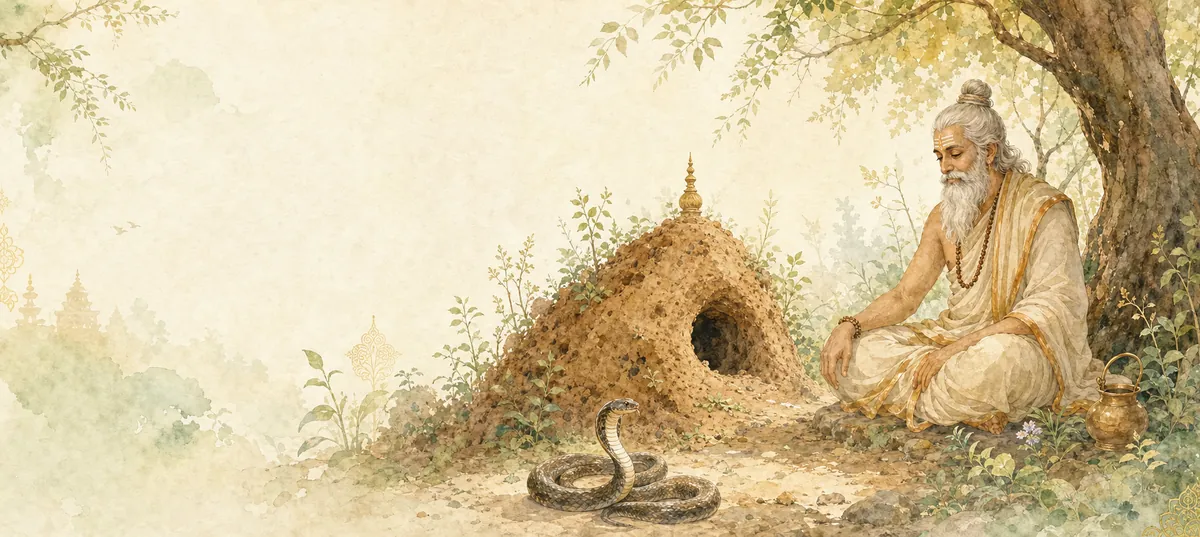
The Teaching of the Twenty-Four Gurus of Dattatreya 22. The Snake. O King, you may notice that a snake moves solely by writhing, not absent-mindedly lost in thought, but always vigilant. Although it has two tongues, it does not make foolish noise. If this body is a transient dwelling place, why should a house be built for it? Moreover, householders know from experience that when a house is built, many cares and anxieties arise. Instead of wasting its time building shelter, the snake lives happily in a hole built and abandoned by white ants. Reflecting on this, I understood that a sage too should follow this example. 23. Th

item image

The Student’s Responsibility on the Path to Self-Liberation

author •date 05.07.2026 •duration 34 min. reading •views 36 просм.

Commentary on the text “Yoga Vasistha,” Chapter 6.1 The Nature of Self-Recognition “When gold is not recognized, it is trampled into the mud. Likewise, when Brahman is not recognized, the mud of misunderstanding arises. One who knows Brahman declares that he himself is God and Brahman, while the ignorant person does not recognize this truth; this non-recognition is called ignorance.” Laya Yoga is also called the school of self-recognition. In the process of self-recognition, we discover the fact of our absolute divine nature. We do not create anything new that we did not originally possess. Yet what efforts it takes for us

item image

View, awareness, conduct: the three pillars of the yogic path

author •date 05.07.2026 •duration 10 min. reading •views 38 просм.

Kommentar zum Text „Moksha Dharma“, Kapitel 275 Yudhishthira sprach: „Über die Befreiung und den Weg, sie zu erreichen, hast du gesprochen, Urgroßvater; diesen Weg möchte ich gründlich kennenlernen, o Bharata.“ Bhishma sprach: „Es gibt nur einen einzigen Weg zur Befreiung. Höre davon im Einzelnen. Man muss den Zorn durch Geduld abschneiden, die Begierde – durch das Fehlen von Träumereien. Der Weise soll die Schläfrigkeit zerstreuen, indem er sich in Klarheit, in Sattva, übt. Durch Wachsamkeit muss man sich vor Furcht schützen, und durch die Tätigkeit des Kenners des Feldes muss man den Atem beherrschen. Man muss durch Stre

item image

The Path to Liberation: Merits and Stages of Yoga

author •date 05.07.2026 •duration 10 min. reading •views 30 просм.

Commentary on the text “Yoga Vasistha” Rama asked: “How does one follow the seven stages of yoga? What are the characteristics of these stages?” Vasistha continued: “A person either accepts the world or rejects it. The former asks: ‘What kind of liberation is this? For me, samsara and life within it are far better,’ and he becomes involved in carrying out his worldly affairs. Through many births he attains the truth. He understands that actions in the world are a futile repetition and does not wish to waste his life immersed in them. He thinks: ‘What is the point of all this? I want to rest from it all.’ And he begins to r

item image

The Wisdom of the Defeated: Indra and Bali’s Dialogue on Time and Dharma

author •date 04.07.2026 •duration 18 min. reading •views 30 просм.

Commentary on the text “Moksha Dharma,” Chapter 223 Vedic Gods Yudhishthira asked Bhishma a question about impermanence: “How is impermanence experienced by the gods who have not attained final liberation, but who possess a divine status?” And Bhishma told him the story of a conversation between the asura Bali and Shakra (Indra), the leader of the celestials. In the battle with the gods, the asura Bali was defeated and gave up all his treasures, but he himself managed to escape. The gods could not find him. Then Indra, having defeated all the asuras, approached the forefather, the lord of the universe—Brahma—and said that

Articles
Vidya AI
Search
Lectures
World Community of Sanatana Dharma
The world community unites people from many countries who belong to Sanatana Dharma (Hinduism) and practice yoga and meditation under the guidance of the enlightened Master of practical Advaita Swami Vishnudevananda Giri Maharaja.
Join Us
support@sanatanadharma.world