Namaste!

item image

The Importance of Serving the Guru: Lessons from the Shri Guru Charitra

author •date 22.06.2026 •duration 8 min. reading •views 38 просм.

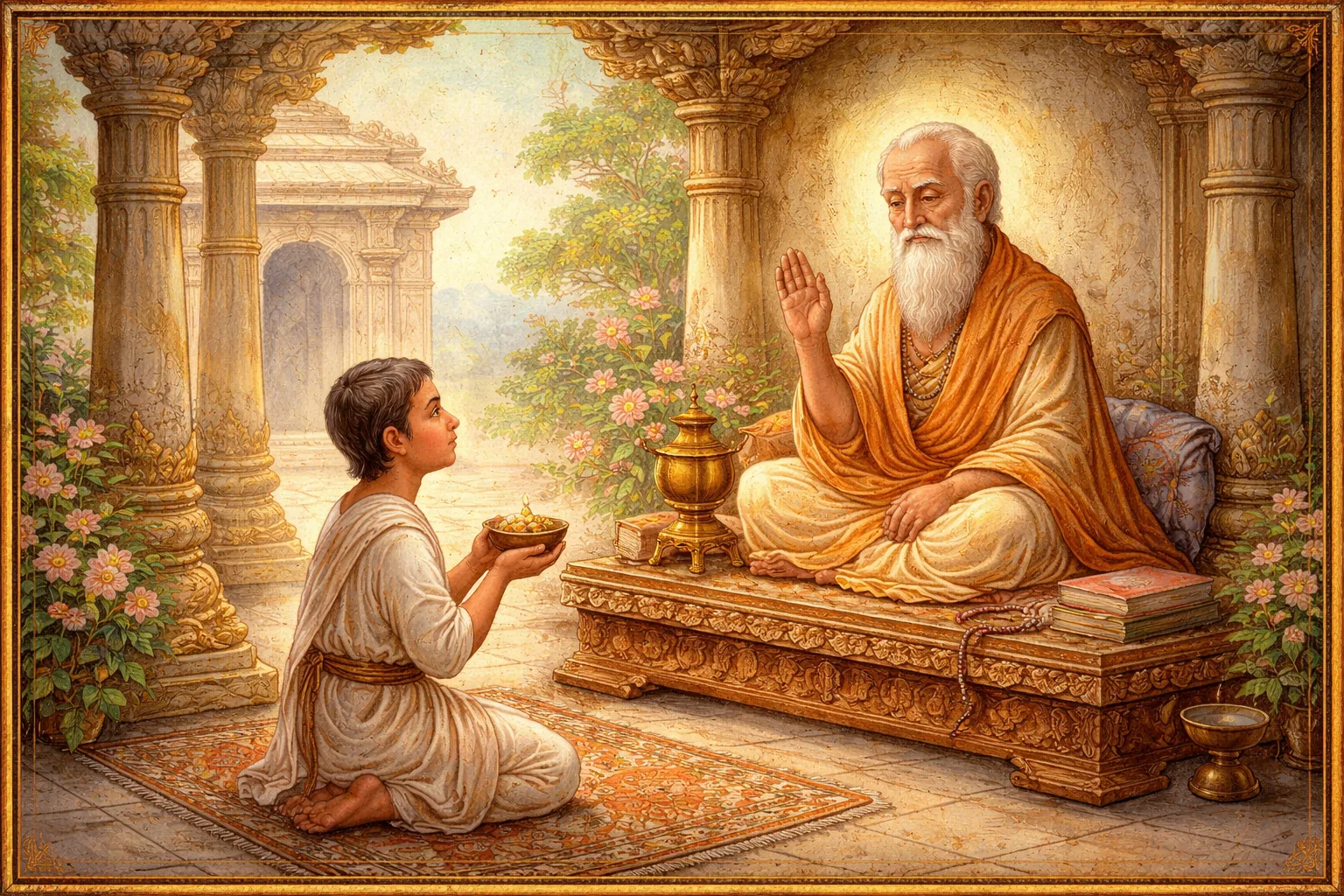
Commentary on the text “Sri Guru Charitra” Continuation of the text “Sri Guru Charitra.” The story of Dattatreya’s incarnation in the form of Narasimha Saraswati. The Story of the Brahmin Muni and the Importance of Serving the Guru Once a Brahmin Muni came to Vaijanath. He prostrated before the guru with devotion and said, “Liberate me. I have not attained enlightenment, although I have practiced austerity. My mind has been purified by your darshan.” The guru said, “How can you become a muni without a guru?” Muni said sadly, “I had a guru, but he was very harsh with me. I stayed with him for a very long time, but it was us

item image

The Pathless Path: The Perfection of the Natural State

author •date 22.06.2026 •duration 13 min. reading •views 31 просм.

Commentary on the text “Kunjed Gyalpo. The Root Tantra” “Other yogas do not truly know the great self-originated wisdom. For this reason, they advance along the path, attain levels of enlightenment, observe vows, and contemplate the view. Accordingly, their view and conduct are ineffective for awakening knowledge of the true state.” Here, lower views are being discussed. This does not mean that other yogas are bad; rather, it is said in order to indicate their subordinate position. If we consider the traditional classification of tantra, then kriya, charya, and yoga are subordinate to anuttara tantra. One can say that all

item image

The ego as the sole cause of suffering

author •date 22.06.2026 •duration 16 min. reading •views 36 просм.

Commentary on the text by Sri Ramana Maharshi “Be As You Are” Question: What do you consider to be the cause of the suffering of the world? How can we contribute to its change individually or together? Maharishi: Realize the Atman, the true “Self.” This is all that is necessary. If Maharishi had given a different answer, he would not have been Maharishi. Ramana does not listen at all to what he is being asked about — this is a sign of a true Teacher. He has no concern for what is said to him, or who says it to him. He is concerned only with awakening from illusions, and everything else has no meaning for him. When such a s

AwakeningEgoSelf-liberationAtmanRamana MaharshiKarmaSelf-surrenderContemplationSuffering
item image

Fundamentals of Spiritual Practice: Motivation, Purification, and Awareness

author •date 22.06.2026 •duration 25 min. reading •views 35 просм.

Commentary on the text “The Liberating Nectar of Precious Instructions” The yogin said: “Such is samsara: whether you are born as a god, a human, a spirit, or an animal, as long as there is no enlightenment, suffering cannot be avoided. Leaving behind all worldly bustle, O wise one, immediately steer your boat toward the shore of enlightenment.” The Four Awarenesses as the Basis of Motivation Before seriously embarking on spiritual practice, we must repeatedly reflect on our motivation in practice. To develop motivation in practice, reflection on the four awarenesses is usually recommended: reflection on impermanence, in p

item image

Arjuna's austerities and his duel with Shiva for divine weapons

author •date 22.06.2026 •duration 17 min. reading •views 29 просм.

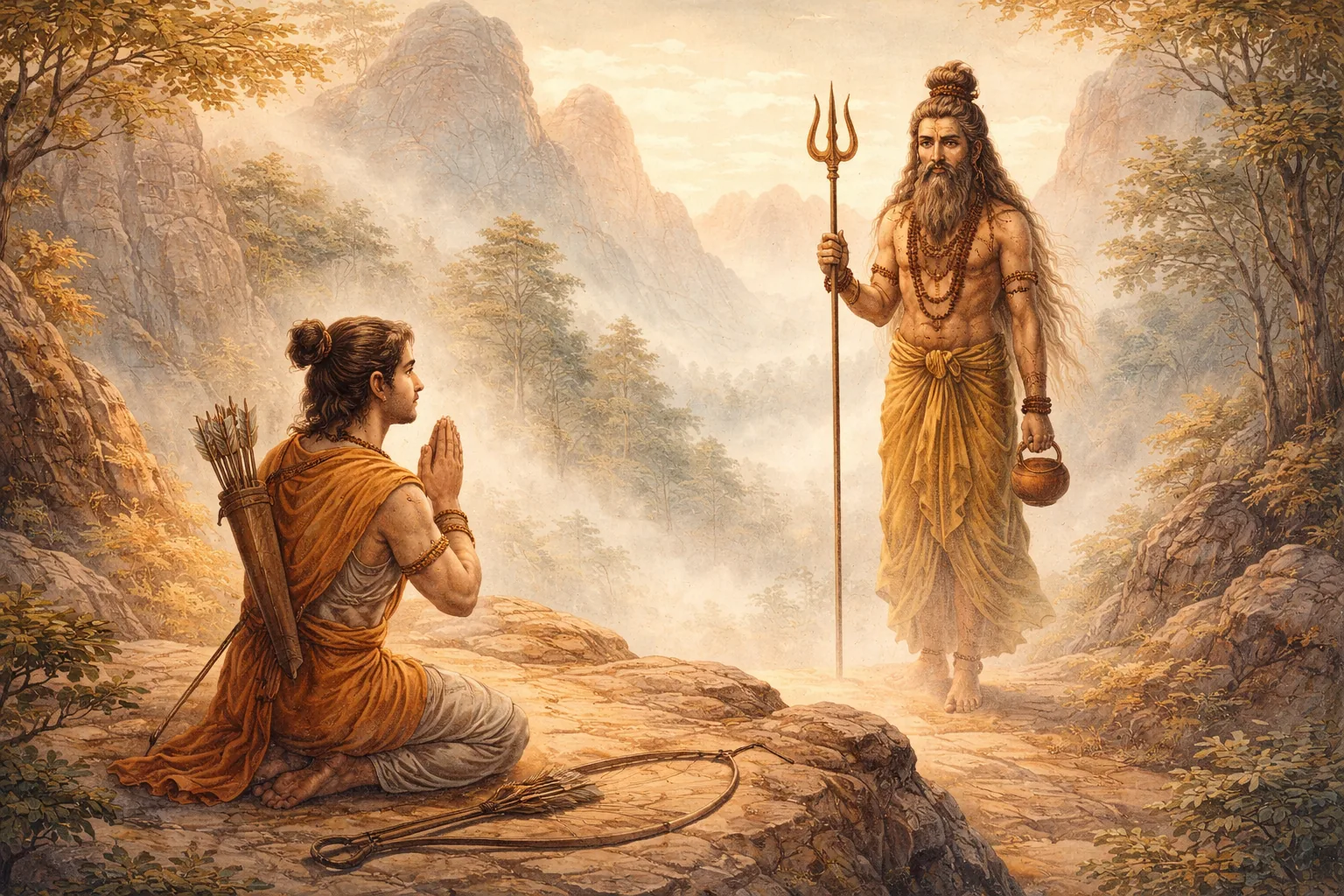
Commentary on the text “Mahabharata,” Book 3 The “Mahabharata,” Book Three, “The Forest,” Chapter 38. A conversation between the rishi Vaishampayana and Janamejaya. Janamejaya wants to know the story of how Arjuna (his great-grandfather) performed ascetic practice, and asks Vaishampayana this question. Vaishampayana is a descendant of Vishampa, a disciple of Vyasa. The narration of the Mahabharata is conducted in his name. So, Vaishampayana says: I will tell you the story of Arjuna and his hand-to-hand combat with Shiva. The Beginning of Arjuna’s Ascetic Practice One day Yudhishthira ordered Arjuna to perform a practice on

item image

Advanced Yoga: 16 Adharas, 3 Lakshyas, and 5 Places of Gorakshanath

author •date 22.06.2026 •duration 6 min. reading •views 39 просм.

Commentary on the text “Siddha-Siddhanta-Paddhati of Goraksha” We continue the instructions on shat-chakra yoga. In the “Siddha-Siddhanta-Paddhati of Goraksha,” in the chapter “The Five Places,” Gorakshanath says: “One who meditates on the nine chakras, the sixteen adharas, and the three lakshyas comes to know these five places, becoming a master of yoga.” Here there are terms or symbols that are not immediately clear: the sixteen adharas, the three lakshyas, and the five places. This is a rather esoteric topic, which should be practiced and understood after you have already, to some extent, mastered concentration on all t

item image

Ashwatthama: The Incarnation of Shiva, His Curse, and the Future

author •date 22.06.2026 •duration 18 min. reading •views 54 просм.

Commentary on the text “Shiva Purana. Shatarudra Samhita.” Chapter 36. “The Incarnation of Shiva as Ashwatthama Nandishvara said: “O omniscient Sanatkumara, listen to the narrative of the incarnation of Lord Shiva, the Great Soul, as Ashwatthama. O sage, although he was an incarnation of the great celestial sage Brihaspati, the self-assured and judicious Drona was born of Bharadvaja, but not from a mother’s womb. He was outstanding among archers, a hero, a sage, a Brahmin, versed in all sciences, endowed with great fame and brilliance, and the most excellent of all who wielded weapons. Learned men knew Drona as the most ex

item image

The direct path to the natural state through the nature of the Mind

author •date 22.06.2026 •duration 10 min. reading •views 36 просм.

Perception of Phenomena and Existential Entanglement We continue to examine excerpts from the tantras that explain the principle of the natural state. “If you perceive phenomena, including the subjective feeling of your ‘I,’ as if they were an independent, self-existent being or objects, you are entangled.” When we perceive an external phenomenon, including even such a phenomenon as our own “I,” as something independent, existing in and of itself, the saints tell us: “You are entangled.” Such deep existential entanglement, which stretches back from past lives, is called karma. By and large, all living beings are entangled.

item image

Mythology of Creation and the Path to Sacred Vision

author •date 22.06.2026 •duration 16 min. reading •views 39 просм.

Commentary on the text “Purusha Sukta” “From his mind arose the moon, from his eye—the sun, from his mouth—Indra and Agni, from his breath—the wind. From him also came the four castes. His mouth became the Brahmin, his arms the Rajanya, his thighs the Vaishya, his feet the Shudra. Seeing no one beside himself, he first said: ‘This is I’; thus the name I arose. Therefore, now, when a person is called, he first of all identifies himself as ‘I,’ and only then names the proper name that belongs to him. And since he, as the foremost of all, consigned all sins to the fire, he is called Purusha. He was afraid; that is why a perso

LingamAnava-yogaNarayanaShivaBrahmaVishnuBrahmandaPrakritiPurusha-sukta
item image

Wisdom as a path to liberation and the overcoming of suffering

author •date 21.06.2026 •duration 20 min. reading •views 33 просм.

Commentary on the text “Yoga Vasishtha,” Chapter Five The story of King Janaka. Vasishtha continues to instruct Prince Rama. Vasishtha continued: “No matter how insurmountable suffering may seem, it is easy to cross it with the boat of wisdom (inner light). One who has no wisdom is troubled even by minor problems. But the wise person easily crosses the sea of suffering, even if he is alone and helpless in this world, and even if he has not studied the scriptures. Even without the help of another, the wise person performs his work perfectly. But it is not so with the fool – he will squander even the wealth he already posses

Articles
Vidya AI
Search
Lectures
World Community of Sanatana Dharma
The world community unites people from many countries who belong to Sanatana Dharma (Hinduism) and practice yoga and meditation under the guidance of the enlightened Master of practical Advaita Swami Vishnudevananda Giri Maharaja.
Join Us
support@sanatanadharma.world